

There are three types of "inability to put things into words"—those that can be fixed with practice and those that will never be fixed

- The contents of "I can't explain it well" are all different.
- Level 1: The perceptive side hasn't caught up yet
- Level 2: Limitations on the side of language as a tool
- Third layer: The moment you try to speak, you're already behind.
- Only one distinguishing question is needed.
- The parts that cannot be put into words are not a flaw
- For Those Who Want to Learn More
- The age of AI where the importance of momentum is increasing—After the gap in intelligence is eliminated by AI, what remains in the end
- How to turn the benefits of ecosystems destroyed by AI to the side of those who benefit from them—and how to leave the other half behind
- The era in which AI will make individuals the most powerful—the reason we stopped looking for abilities that can't be matched by AI
- Frequently Asked Questions
The contents of "I can't explain it well" are all different.
My opinions don't take shape in meetings. When asked for my thoughts, only "it was good" comes out. I can't explain what I'm struggling with.
They are all said to be unputinto words. But what is happening is not the same.
Some people change dramatically through practice in verbalization, while others return to the same place no matter how many books they read, because they do not distinguish this difference.
The criterion for division is which side the limit lies on: in our perception, in the tool of language, or in the act of writing itself.
Level 1: The perceptive side hasn't caught up yet
I don't know the right words. I don't have the concept. Or I have the materials, but they aren't in order. That's why I can't point to it.
This will be resolved through practice: writing things down, learning names, and pouring them into formats. Just by increasing your available vocabulary by one, a vague mass suddenly breaks apart.
What you need to keep in mind is that the moment you realize you cannot put something into words, you are already on the side of being able to say it. The object that you can say you do not yet know has already entered the realm of meaning as something that can be known. All that is left is to go and fetch its name.
The know-how available in the world works for this demographic.
Level 2: Limitations on the side of language as a tool
There is no way to convey the red I am seeing to others. Even if I describe it as the color of blood, there is no guarantee that the red that arises inside the other person is the same.
This is the stratum Wittgenstein referred to at the end of the Tractatus Logico-Philosophicus when he wrote, "Whereof one cannot speak, thereof one must be silent." Ethics, aesthetics, and the religious—he classified them all here.
This layer cannot be filled even by increasing the vocabulary. This is because the limitation lies on the side of the medium of expression.
However, there are things we can do: use non-verbal channels such as poetry, music, or simply spending time together. Even if we cannot point the way, we can stand beside each other.
Third layer: The moment you try to speak, you're already behind.
There is a moment when something suddenly catches your attention. It's just a fraction of a second before it even becomes the word "curiosity."
When I look back to put it into words, I am already too late. By the moment I look back, it has already taken shape as meaning.
The limitation here is not a lack of perception or the performance of the medium, but the very structure of the operation of writing itself, which can only capture the results after they have already emerged.
What's more, this delay cannot be made up for no matter how precisely you write. The moment you write that you have captured the foreground, that sentence becomes the aftermath of its own emergence, and a new foreground forms behind it. Every time you add to it, you retreat by the exact same distance.
This layer is called structural indescribability, and it cannot be resolved by either the expansion of cognitive abilities or the refinement of language.
Only one distinguishing question is needed.
Will it become possible to write about that if I could know more, or if I had more appropriate words?
If it's going to happen, it's in the first layer, where effort works. If it can reach you by changing the channel of communication, it's in the second layer, where detours work. If it's neither, it's in the third layer, and that is not a place to be filled.
When mixing things up, you get the direction wrong. If you mistake the first layer for the third, you mystify something that could be resolved simply by studying. If you mistake the third layer for the first, you endlessly continue self-analysis and wear yourself out.
The parts that cannot be put into words are not a flaw
What remains in the third layer does not need to be considered immaturity.
If there were a world where words matched their objects perfectly, we would no longer need to think. The reason we keep thinking always lies beside the gap that can never be filled. Yet, the moment we feel we have successfully put something into words, something invariably spills out from it. That spilled remainder becomes the space for our next thought.
For Those Who Want to Learn More
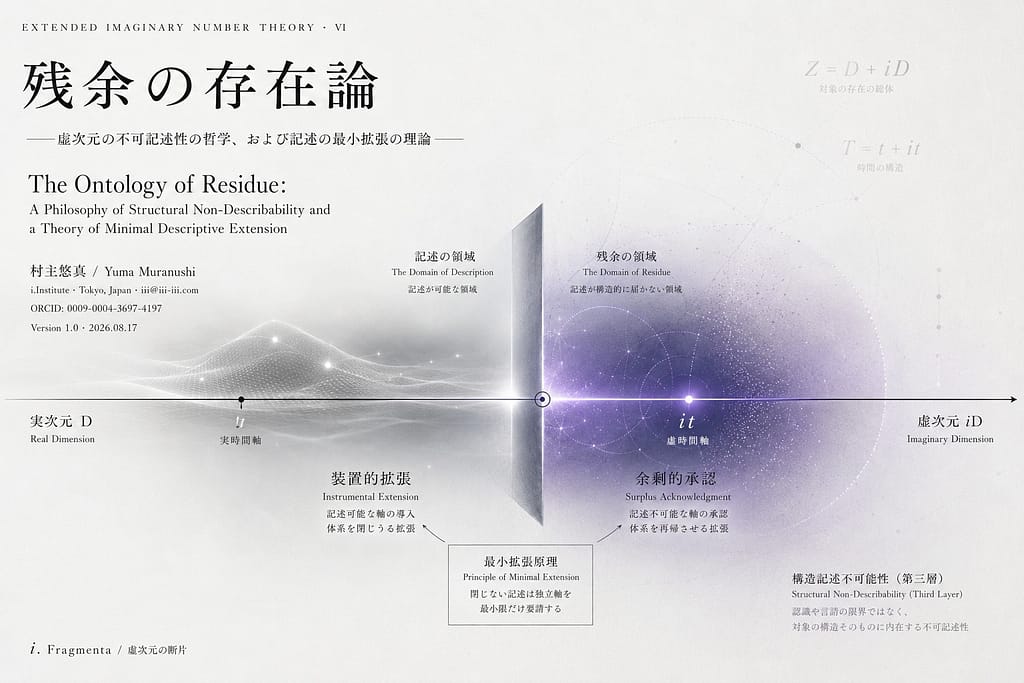
The categorization of inexpressibility into three layers and the positioning of the third layer as belonging to the structure of the object rather than to cognition or language are addressed in the sixth paper of the Extended Imaginary Number Theory series.
↓Click here for *The Ontology of the Residual: A Philosophy of the Indescribability of the Imaginary Dimension and a Theory of the Minimal Extension of Description* (Yuma Murashu, 2026)↓
The demonstration itself that the description misses the emergence is in the fourth essay.
↓ "The Far North of Realist Monism: At the End of Reductive Physicalism" (Yuma Suguhi, 2026) is here ↓
↓Related articles are here↓
↓ Latest articles are here ↓
-
The age of AI where the importance of momentum is increasing—After the gap in intelligence is eliminated by AI, what remains in the end
This article examines what makes the difference in the AI era. In conclusion, it is said that "the part of the brain that is responsible for thinking and creating ideas..."
-

How to turn the benefits of ecosystems destroyed by AI to the side of those who benefit from them—and how to leave the other half behind
It is believed that businesses should start with what they want to do. However, the advent of AI is bringing a new wave to that. Sales…
-

The era in which AI will make individuals the most powerful—the reason we stopped looking for abilities that can't be matched by AI
Creating apps that only you use every day—replacing search or updating a handy tool for when you’re stuck—in an instant, now with AI…
Frequently Asked Questions
There are three types of misunderstandings: not being able to keep up with understanding, the limitations of the tool of language, and being late when trying to speak.
The first layer, where recognition is not yet up to par, can be improved through training in increasing writing and vocabulary. The other two cannot be improved through practice.
It is not a defect. It arises from the limitations of language and the very act of speaking; rather, it may contain important information.


