

"Only what can be counted is real" - Realism, the unconscious of the last 400 years of modernity

- Nature is written in the language of mathematics.
- The moment a handstand happens
- And humans themselves will be quantified.
- The overlooked "surplus"
- "Narrowness", not "error"
- Realism is not wrong, it is narrow.
- Increasing the granularity of memory settings — for those who are concerned about the finer details, here’s why changing the focus can reveal the big picture
- The difference between growth and evolution: Feeling joy in growth means closing off possibilities
- If you want to win, first you have to lose—The reason why people who know how to lose always win in the end, and the boundary between "a habit of losing" and "winning"
- Frequently Asked Questions
Nature is written in the language of mathematics.
The origin of this belief traces back 400 years to a physicist. Galileo declared, "The great book of nature is written in the language of mathematics." He described the fall of objects as a function of time and distance, and then expanded upon it with formulas. This, he proclaimed, was the correct way to understand nature.
This step contained two premises, folded within themselves so deeply that the individual himself wasn't even aware of them. The first is a claim at the level of existence that what is contained within nature is limited to what can be captured mathematically. The second is the demarcation that things which cannot be expressed mathematically, such as color, scent, warmth, and value, belong not to nature but to our subjective side. The moment these two were linked, the program of modern science was launched: That which is real is that which can be written down as a numerical value.
The moment a handstand happens
Here, a often overlooked reversal occurs. This is something Husserl keenly pointed out. Originally, mathematical formulas were tools to organize the rich experiences before us. Wavelengths were a way to handle colors, frequencies a way to handle sounds; they were means, so to speak. However, at a certain point, this relationship is inverted.
WavelengthNumbers are "true reality."elevated, and the red and blue that are actually seen are demoted to "subjective images." Mathematization, which was supposed to be a means, unexpectedly becomes the foundation of experience itself. Husserl, seeing this inversion,CrisisHe called them that. The reason we feel "numbers are reality" is because we've inherited this inversion without realizing it.
And humans themselves will be quantified.
This stance did not remain solely within the realm of physics. It spread outwards, transforming itself, first in the latter half of the 20th century, as a position that reduces the mind to the physical state of the brain, and in the 21st century, as a worldview that considers the universe itself as a colossal computation.
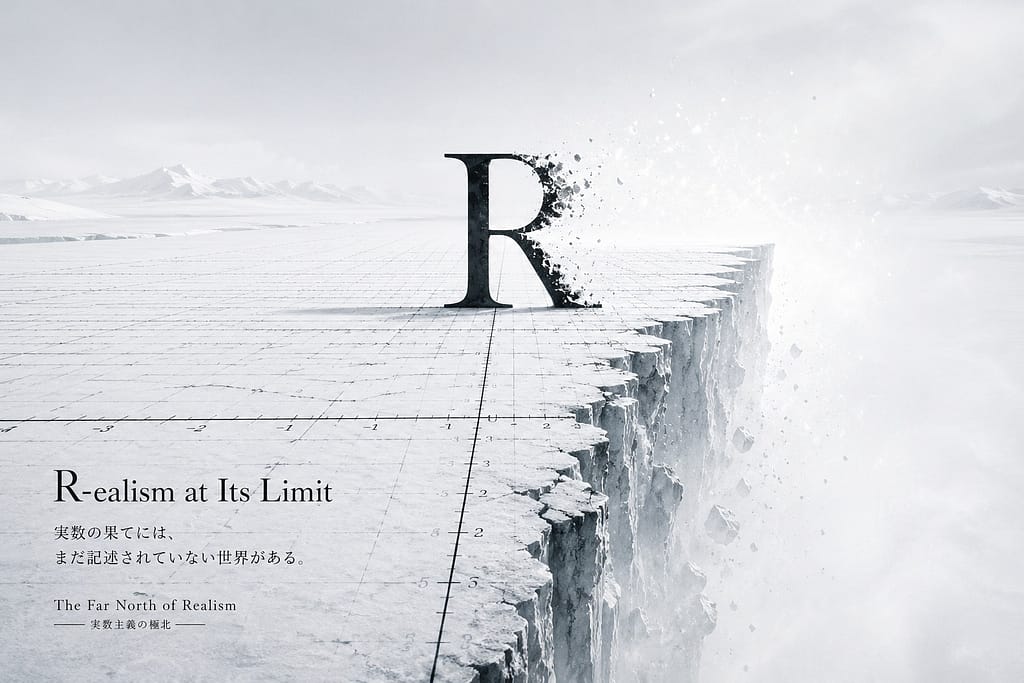
And finally, we reach human beings themselves. Evidence-based policymaking, Effective Altruism that quantifies the value of life with QALYs, AI-driven optimization decisions, and performance evaluations based on KPIs. The mathematization that Galileo performed on nature is now being performed on humans. These are all merely domain-specific implementations of the same underlying framework. In the Extended Imaginary Number Theory series of papers by Suganami, this stance is called R-ealism.
The overlooked "surplus"
No matter how precisely you count, there will always be something that hasn't yet arisen accompanying the object. Descriptions can only capture results that have already taken shape. The moment before that shape emerges is not written into any number. Realism has expelled this leftover element, labeling it as "subjective" or "a phenomenon to be explained later," pushing it outside of reality.
However, even if driven out, they don't disappear. They continue to exist as a structure that cannot be fully contained.
"Narrowness", not "error"
What I want to emphasize here is that I am not completely denying realism. The way nature is mathematized is one of the best parts of human knowledge that has supported the cumulative success of science since the modern era. As a means, it is exceptionally effective.
There is only one thing that should be rejected—the step of equating its methodological success with a "complete description of the world itself." No matter how accurate a map is, a map is not the territory itself.
Realism is not wrong, it is narrow.
Just as the real number R is merely a part (the real part) of the broader complex number C, the reality depicted by numbers is also only a small part of a larger existence. Before dismissing the immeasurable as mere "imagination," one should question which coordinate system they are currently observing from. What Visua Plus calls "structural vision" is precisely this step.
↓The fourth paper, "The Far North of Realism," is here↓
↓Related articles are here↓
↓ Latest articles are here ↓
-

Increasing the granularity of memory settings — for those who are concerned about the finer details, here’s why changing the focus can reveal the big picture
I worry about paying 10 yen per item. That in itself isn't bad. However, humans have a focus, and when you direct your attention to fine details, the big picture emerges...
-

The difference between growth and evolution: Feeling joy in growth means closing off possibilities
Growth and evolution are not the same thing. However, how do you generally use this term? Growth refers to the process of developing from a simple organism to a more complex one.
-

If you want to win, first you have to lose—The reason why people who know how to lose always win in the end, and the boundary between "a habit of losing" and "winning"
People who keep winning won't be able to move on after one day. People who have never lost are probably just playing only winning games...


Frequently Asked Questions
This is a powerful worldview that holds that only what can be counted and measured is real.
It's not that it's wrong; it's just that it's narrow-minded. It's also an effective approach that has supported the development of science and technology.
It is a "surplus" that is difficult to quantify, such as love, trust, meaning, and creativity.


