

What is a Coordinate System: Expanding the Concept of ”Spatialization of Thought” Which is Decisively Different from Perspective or Standard

"Have your own axis," "Think on your own axis." - These are phrases I've been encountering more and more often lately.
However,What is a coordinate axis?Few people can explain this properly. And why must this word be ”coordinate axis” and not "perspective" or "standard"? The moment you understand this, the depth of your thinking changes by another level.
- The coordinate system is originally a mathematical term—a set of three elements: an origin, a scale, and orthogonality.
- Why ”coordinate axis” and not "viewpoint" or "standard"?
- To set up coordinate axes is to ”spatialise” a concept.
- Increasing the granularity of memory settings — for those who are concerned about the finer details, here’s why changing the focus can reveal the big picture
- The difference between growth and evolution: Feeling joy in growth means closing off possibilities
- If you want to win, first you have to lose—The reason why people who know how to lose always win in the end, and the boundary between "a habit of losing" and "winning"
- Frequently Asked Questions
The coordinate system is originally a mathematical term—a set of three elements: an origin, a scale, and orthogonality.
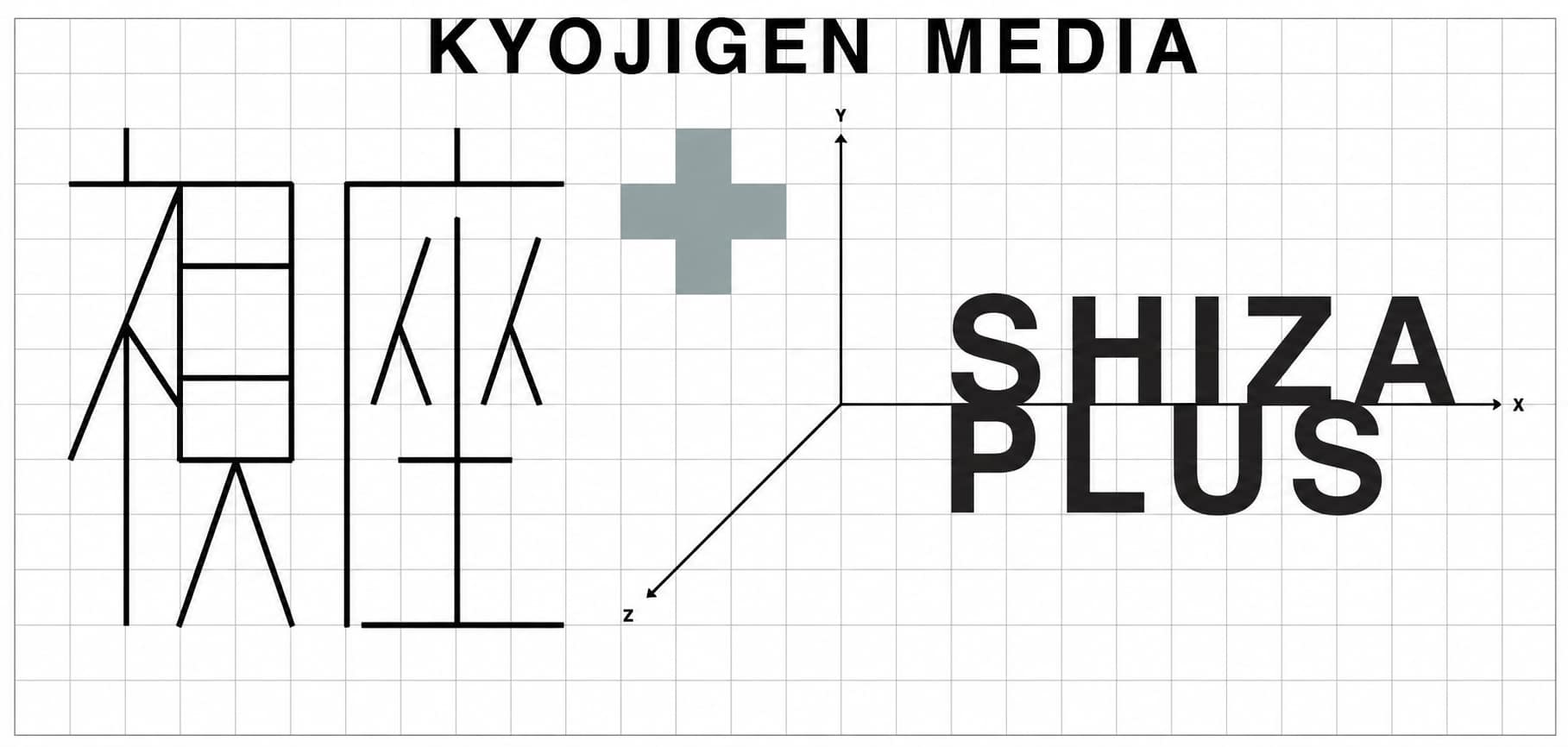
The term "coordinate axis" originally comes from mathematics. The x-axis, y-axis, and z-axis each have independent directions that are orthogonal to each other, and they function as rulers to measure distance from a reference point called the origin. And it is only when those axes are combined that "Spaceis defined.
In other words, the coordinate axes simultaneously contain three attributes that are not present in any of their synonyms, such as "viewpoint," "standard," or "ruler."
First,There is an originSecond,The scale is markedThird,Being orthogonal to other axes。
Among the many "thinking words," only "coordinate axis" has these three components. The true meaning of the phrase "to have a coordinate axis" refers to the state of having these three components established within oneself.
Why ”coordinate axis” and not "viewpoint" or "standard"?
Here's the core point that many people get wrong.
"Viewpoint" only indicates a position. It lacks a scale and any relational structure with other viewpoints. "Standard" can draw lines of comparison, but it lacks direction. "Ruler" has a scale, but it is fundamentally confined to one dimension.
For these, only the coordinate axesPreserve direction, origin, scale, and orthogonality simultaneouslydoing.
The key to taking your thinking a step deeper is this:OrthogonalityThe concept of orthogonality means independence, where moving along one axis does not affect the values on the other axes. Only humans who can simultaneously have multiple independent axes can handle complex phenomena multidimensionally.
No matter how many viewpoints you add, they only expand two-dimensionally. The moment the axis stands, thought expands into ”space.” This is the decisive function, where the coordinate axes are different from any other thought idiom.
To set up coordinate axes is to ”spatialise” a concept.
The simplest way to adapt coordinate axes for thinking is to re-establish every concept as an "axis."
For example, "freedom." Instead of treating it as a mere value, treat it as a single axis with a scale from 0 to 100. Then, in combination with other axes—order, responsibility, solitude—Be able to measure your current coordinatesThe vague self-awareness of "valuing freedom" transforms into concrete coordinates of "Freedom 80, Order 40, Responsibility 70." Thought shifts from a fog of words to spatial positioning.
Reframing things that cannot be captured by visible reality onto orthogonal, imaginary dimensional axes – this is the greatest aspect of the term "coordinate axis."Concept ExpansionThat's right.
Instead of people who increase perspective,Someone who upholds principlesOnly we can spatialize thought.
To see the world is to establish a coordinate system. That is one's perspective.
↓ For those who want to learn more about coordinate axes, check out the "Theta Corridor" now ↓
If you've read the article about coordinate axes, you might also like this one:
↓Click here for the latest articles↓
-

Increasing the granularity of memory settings — for those who are concerned about the finer details, here’s why changing the focus can reveal the big picture
I worry about paying 10 yen per item. That in itself isn't bad. However, humans have a focus, and when you direct your attention to fine details, the big picture emerges...
-

The difference between growth and evolution: Feeling joy in growth means closing off possibilities
Growth and evolution are not the same thing. However, how do you generally use this term? Growth refers to the process of developing from a simple organism to a more complex one.
-

If you want to win, first you have to lose—The reason why people who know how to lose always win in the end, and the boundary between "a habit of losing" and "winning"
People who keep winning won't be able to move on after one day. People who have never lost are probably just playing only winning games...


Frequently Asked Questions
It has the three features of origin, scale, and orthogonality simultaneously, and is a structure for handling thought as a space.
The perspective only shows the position; the reference line only indicates the direction of comparison. Only the coordinate axis has all the properties of direction, origin, scale, and orthogonality to other axes.
It is about resetting concepts like "freedom" and "responsibility" as axes with a scale of 0 to 100, and measuring our own position.


