
Master Suguru's Fourth Paper, "The Far North of Realism," is Complete! — "Realism is not wrong, it's narrow."
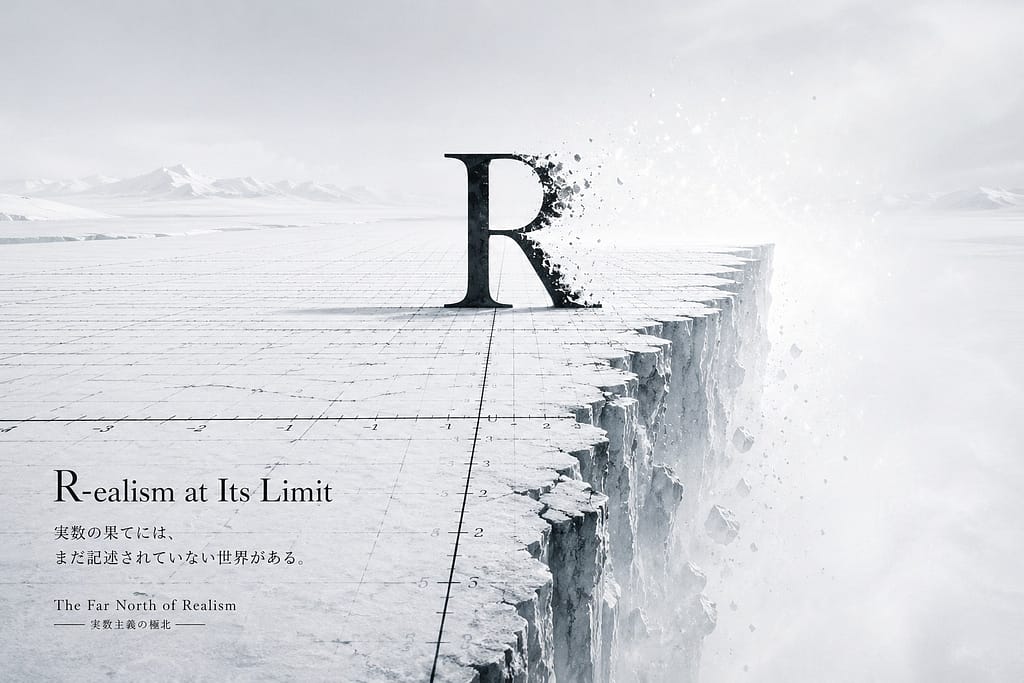
I've finished writing the fourth paper in the Extended Imaginary Theory series, titled "The Far North of Realism: Beyond Reductive Physicalism." This paper takes a very different approach to writing compared to the previous three. While I understand no one is paying attention to this, today I'd like to talk about that "approach."
- This is my first time writing from the outside.
- Only based on the other party's logic, open it up to the outside.
- Real numbers are just the real part of complex numbers.
- Inclusion, not exclusion.
- Realism is not wrong, it is narrow.
- What creates people is the illusion of a "past"—as long as we protect it, the next one won't come.
- Nothing is greater than your own capacity—no one, no information, no money, everything is determined by the limits of your tolerance.
- What is playfulness? It is not about messing around, but the power to "shift the established."
This is my first time writing from the outside.
From the first paper to the third, I've imposed a rule on myself. It's a principle of structural avoidance: to focus solely on describing the real dimension D, without directly discussing the imaginary dimension iD. If I say too much, the imaginary dimension will immediately retreat. Therefore, I want to outline its shape by carefully depicting its surroundings.
This time, I lifted this self-restriction just once. The series has implicitly dealt withAntithesis: The position that "the universe is closed off in the real dimension D alone."It makes that thing the direct subject.
Only based on the other party's logic, open it up to the outside.
However, in the critique section, I did not bring in any arguments from the side of imaginary dimensions. I only used the logic of the opponent—real numberism—itself. My sole focus was on showing the point at which the opponent, when carrying that logic to its extreme, would open up externally by their own hand.
The non-closed nature of description appears at the end of this penetration. In any aspect, whether experience, meaning, or event, description can capture the resulting outcome, but it always leaves behind what precedes it. This is not an external objection, but a limitation arising from within the act of description itself.
Real numbers are just the real part of complex numbers.
So, how do we write this leftover surplus? Here, I borrowed an idea from mathematics. When the real numbers R were not algebraically closed, mathematics neither devalued the real numbers nor left a void. By minimally augmenting the system with a new axis, i, orthogonal to R, the system was closed. While i is outside of R, it is not imaginary. It connects with R to complete the system for the first time.
The position of the virtual dimension iD relative to D is no different from this. iD is not the name of a newly discovered entity, butIt must be written as a single descriptive direction independent of D.and the name given to that situation.
Inclusion, not exclusion.
Therefore, this paper is not intended to crush nominalism. On the contrary, it is the opposite. Extended realism first restores qualities, meanings, and forms, which nominalism has dismissed as "subjective," back into reality as legitimate components of D. Then, it re-situates what any description still leaves behind at the threshold of emergence as iD on the side of reality. The sophistication that nominalism achieved in the domain of D is preserved intact as part of itself.
Realism is not wrong, it is narrow.
This single sentence encapsulates the entire paper. The reality depicted by numbers is not wrong. It is merely a real part of a larger reality. I have painstakingly used difficult expressions to convey this one point, so please take this opportunity to read it, as a Japanese version is also available.
↓The fourth paper, "The Far North of Realism," is here↓
↓Related articles are here↓
↓ Latest articles are here ↓
-

What creates people is the illusion of a "past"—as long as we protect it, the next one won't come.
People are made up of what they have built up through their lives. They must cherish and protect what they have built, rise from failure, and continue to waver between regret and hope...
-
Nothing is greater than your own capacity—no one, no information, no money, everything is determined by the limits of your tolerance.
No good news comes. There are times when I feel that I haven't been lucky. But it's not that I haven't received it; it's just that I haven't been able to receive it...
-

What is playfulness? It is not about messing around, but the power to "shift the established."
Don't be fooled by the idea that "playfulness equals fooling around." First and foremost, playfulness is not just about messing around and being lazy...