

Even if you train your questioning skills, the questions won't change—your questions are already decided before you even think about them.

- People who always ask the same questions
- Where does the question come from?
- You can't notice "things you didn't ask about."
- The only way to change the way questions are asked
- For Those Who Want to Learn More
- The age of AI where the importance of momentum is increasing—After the gap in intelligence is eliminated by AI, what remains in the end
- How to turn the benefits of ecosystems destroyed by AI to the side of those who benefit from them—and how to leave the other half behind
- The era in which AI will make individuals the most powerful—the reason we stopped looking for abilities that can't be matched by AI
- Frequently Asked Questions
It is said that the ability to formulate good questions is important, and there are numerous books and frameworks on questioning skills available.
However, even if you learn the techniques, the form of the questions you ask will hardly change.
The reason for this is because the question is not born from "the result of thinking," but from the "position" one takes before thinking.
People who always ask the same questions
A asks, "How much will it sell?" B asks, "Who will use it in what situations?" C asks, "Is it even needed in the first place?"
And at the next meeting, the three of them ask almost the same type of questions. Even when the topic changes, the question structure remains the same.
This tends to be dismissed as a matter of personality, interests, or the nature of the work being handled. However, there are not few people who do not change the form of the question even when their position or responsibilities change. At the core of this, there is a more fundamental mechanism at work.
Where does the question come from?
We think that multiple layers overlap at the center of a person’s perspective. Who am I? What is important? What truly exists? And what is worth questioning?
This final layer determines the scope of the question. For those who value sales, the question of “how to sell” naturally arises; for those who value human happiness, the question of “how to deliver” naturally follows. Unless the question changes, no matter how much information is gathered, the answer will always be similar.
You can't notice "things you didn't ask about."
The annoying thing is that what is deemed not worth asking can’t be rejected after being considered; it simply doesn’t come to mind in the first place. People don’t notice what they haven’t thought of.
The fact that no one at the meeting even starts by asking the question “in the first place, is this project worth doing?” does not necessarily mean that everyone has considered and rejected that question. In the organization’s assumptions, it often doesn’t even occur to anyone.
When children ask, "Why do adults have to work?" adults get flustered because the question they have been holding back is one that the children are more than willing to answer.
The only way to change the way questions are asked
Even if I try to think of a better question, the question itself will not change as long as I remain in the same place where I am thinking. What will work is the experience of being shaken by the premise.
Spend time talking with someone with a completely different mindset. Question what you thought was obvious. When your footing is slightly off, an unexpected question comes to mind. As the question changes, the range of answers you reach is completely replaced. The quality and quantity of this become important elements of the plasticity of your thinking.
For Those Who Want to Learn More
The line drawn in this article regarding “what is worth questioning” is positioned as one of the four underlying layers that overlap at the center of the paper. The peeling off and re-assembling of those underlying layers is the central theme of the paper.
Muramizu Yuuya (2026) "Coordinate Structure Theory of Perspective: The Mechanics of Origin, Axis, and Motion"
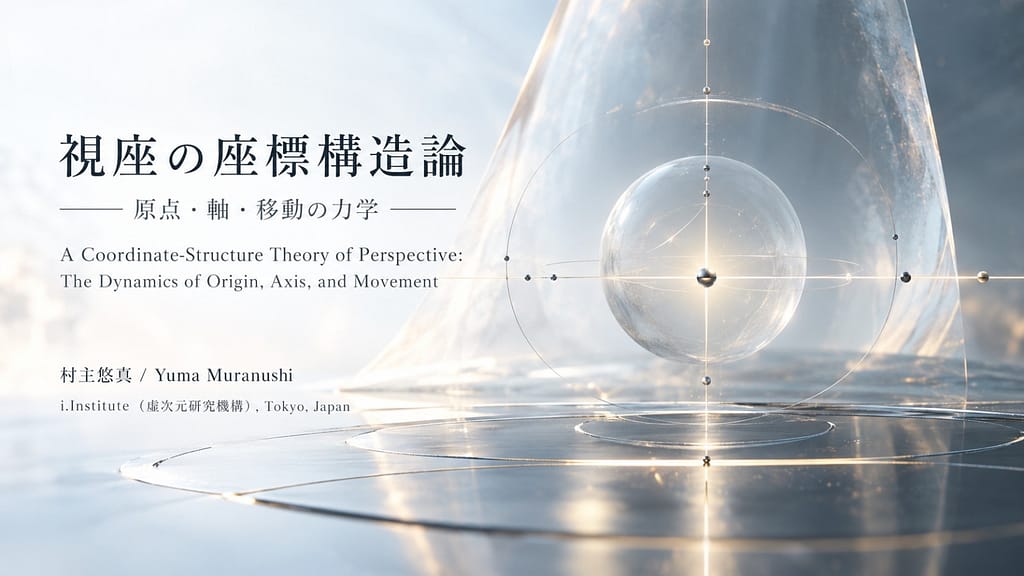
Murashu Yuu-chan (2026) "Extended Hypergeometry Theory: Z = D + iD as a Dual Structure of Existence"

↓For those who want to know more, check out "θ-galleries" now↓

↓Related articles are here↓
↓Latest posts are here↓
-
The age of AI where the importance of momentum is increasing—After the gap in intelligence is eliminated by AI, what remains in the end
This article examines what makes the difference in the AI era. In conclusion, it is said that "the part of the brain that is responsible for thinking and creating ideas..."
-

How to turn the benefits of ecosystems destroyed by AI to the side of those who benefit from them—and how to leave the other half behind
It is believed that businesses should start with what they want to do. However, the advent of AI is bringing a new wave to that. Sales…
-

The era in which AI will make individuals the most powerful—the reason we stopped looking for abilities that can't be matched by AI
Creating apps that only you use every day—replacing search or updating a handy tool for when you’re stuck—in an instant, now with AI…
Frequently Asked Questions
Rather than learning the techniques of asking questions, it is important to move beyond the “position” before thinking. When you talk to someone with a completely different way of thinking or question the obvious, new questions will naturally arise.
The question arises not from the result of thinking, but from the premise of “what is worth asking?” If the premise remains the same, the form of the question does not change either.
What is deemed not worth asking doesn’t even come to mind in the first place. By engaging with the simple questions of children and the perspectives of people from different backgrounds, we can become aware of the questions we have been holding back.


