

It's only natural not to be able to focus on the "here and now" — the present is not a point, but a thick layer.

- Not being able to return to the breath is not a failure
- There are no answers in the direction of time ticking away.
- The present has depth.
- Reference and coexistence are separate events.
- Trying to eliminate distracting thoughts does not work
- "Here and now" is the thickest place
- For Those Who Want to Learn More
- The age of AI where the importance of momentum is increasing—After the gap in intelligence is eliminated by AI, what remains in the end
- How to turn the benefits of ecosystems destroyed by AI to the side of those who benefit from them—and how to leave the other half behind
- The era in which AI will make individuals the most powerful—the reason we stopped looking for abilities that can't be matched by AI
- Frequently Asked Questions
Not being able to return to the breath is not a failure
You are told to return here now. You direct your awareness to your breath. Three seconds later, you are thinking about tomorrow's meeting.
Many people feel that they are not suited for it.
However, one of the reasons it doesn't go well lies in the understanding of the word "now," rather than in our abilities.
There are no answers in the direction of time ticking away.
Let us think of it this way: the present is the boundary between the past and the future.
Then things get strange. There is no width to the boundary. If there is no width, nothing happens there. How is it possible to stand on a point where nothing happens?
Making the increments finer doesn't solve it. Even if you break a second down into a thousandth, that instant only approaches a point without width, moving further away from the felt sensation of "now" that is actually being experienced.
It's the same even if you replace it with an interval. Thickness is not a property that can be extracted by manipulating the time axis.
The present has depth.
When listening to music, what reaches the ear should be only a single note playing at that exact moment.
However, what is actually being heard is a melody.
The sound that just rang out is placed upon a layer where the immediately preceding sound has not yet completely faded away. That is precisely why it is heard as a phrase rather than a mere sequence of sounds. In phenomenology, this layer is called retention.
If the present were truly a point without breadth, music could never exist.
Reference and coexistence are separate events.
Suppose you happen to stop by the kitchen and catch the scent of incense. It is the smell of your grandfather's house, who passed away decades ago. You can explain that it brought back memories of the past. That is an explanation of referencing a point in the past along a timeline.
However, the feeling can sometimes be a bit different. Rather than having remembered it, that scene is here, inside this very moment, existing right alongside me.
Reference is a relation between two points on a time axis. Coexistence is a relation within a single present. The two belong to different categories.
And the magnitude of the separation adds nothing to this distinction. Whether it is a sound from two seconds ago or a scent from twenty years ago, as long as it bites into the current layer, the structure is the same. The fact that multiple things belong to a single place in a way that cannot be reduced to the order of the time axis is called structural simultaneity.
Trying to eliminate distracting thoughts does not work
When you try to focus by thinking of the present as a dimensionless point, your work ends up like this: you banish every just-passed sensation and every faintly anticipated next moment as mere distractions.
This is exhausting. Moreover, what remains once you've driven everything out is a narrow, empty place.
Looking at the present as layers, the work changes. Something is emerging right now. Just before it, there is something that has not yet completely faded. Even further back, something without a name is moving.
Instead of erasing them, leave them as they are, as things of different depths.
Concentration is not about narrowing down, but about being able to see the depth.
"Here and now" is the thickest place
Now, it is thought to be the thinnest place. The past is long, the future is vast, and only the present is a fleeting gap.
However, the order might be reversed.
Neither in the past nor in the future, it can only be touched within the layer of the present. The place that can be touched is always only here.
And here, the sounds of two seconds ago, the scents of decades past, and premonitions not yet put into words all coexist at varying depths.
Right now, this is not a point.
It is the thickest place.
For Those Who Want to Learn More
The proof that the current thickness cannot be recovered either by the subdivision of the time axis or by the replacement with intervals can be found in the fifth paper of the extended imaginary number theory series.
↓Click here for "Imaginary Time: The Non-Closure of Description and the Principle of Minimal Extension" (Yuma Murasugi, 2026)↓

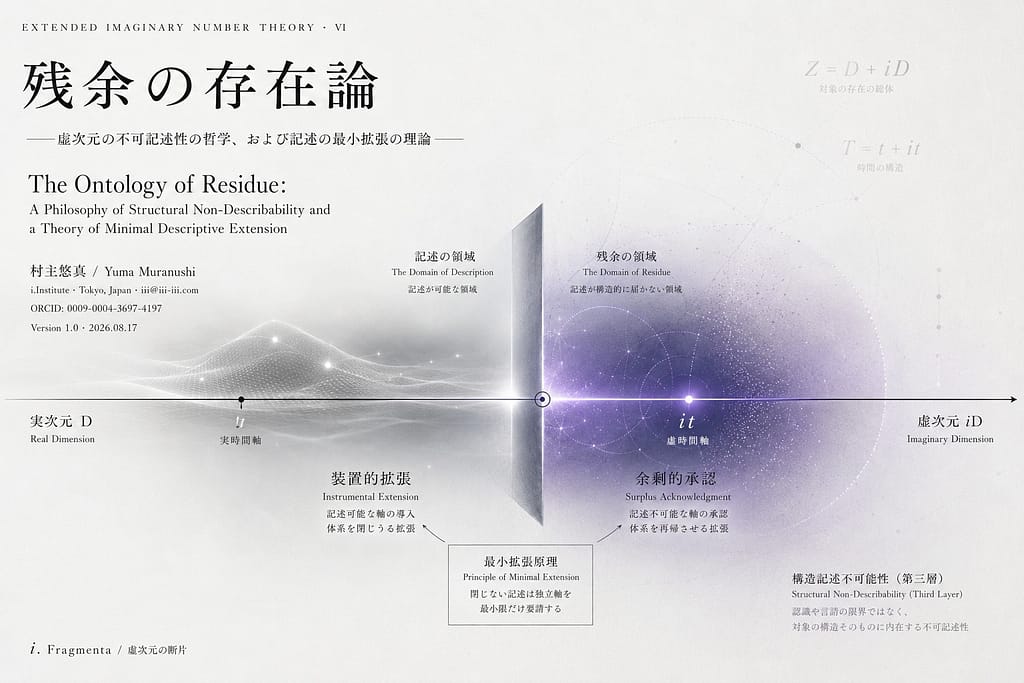
The generalization of structural simultaneity, which holds regardless of the magnitude of separation, is given in the sixth paper.
↓Click here for *The Ontology of the Residual: A Philosophy of the Indescribability of the Imaginary Dimension and a Theory of the Minimal Extension of Description* (Yuma Murashu, 2026)↓
↓Related articles are here↓
↓ Latest articles are here ↓
-
The age of AI where the importance of momentum is increasing—After the gap in intelligence is eliminated by AI, what remains in the end
This article examines what makes the difference in the AI era. In conclusion, it is said that "the part of the brain that is responsible for thinking and creating ideas..."
-

How to turn the benefits of ecosystems destroyed by AI to the side of those who benefit from them—and how to leave the other half behind
It is believed that businesses should start with what they want to do. However, the advent of AI is bringing a new wave to that. Sales…
-

The era in which AI will make individuals the most powerful—the reason we stopped looking for abilities that can't be matched by AI
Creating apps that only you use every day—replacing search or updating a handy tool for when you’re stuck—in an instant, now with AI…
Frequently Asked Questions
It is one of the reasons that it is not a question of ability but rather a result of understanding the "now" as a narrow, finite point of view.
Currently, it means there is a depth created by the lingering aftertaste of the previous moment and the anticipation of what will happen next.
Trying to eliminate it won’t work well at all. What we need to do is to accept it with the thick “now” and let the distractions coexist with it.


