
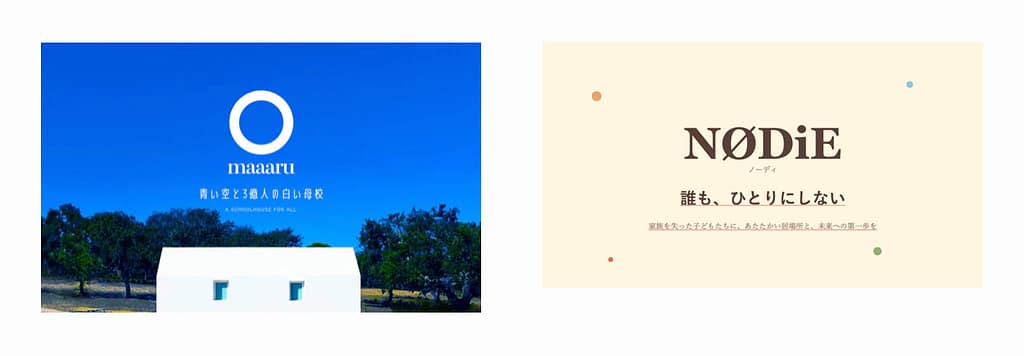
A place where you can say "Welcome home" all over the world – What NØDiE questions
![[Tour Participants Wanted] A place where you can say "Welcome back" all over the world – NØDiE's re-examination](https://mlqu45y6h5tw.i.optimole.com/w:1024/h:538/q:mauto/f:best/https://iii-iii.com/i.media/wp-content/uploads/2026/04/8.png)
NØDiE -- Thinking from a Project Perspective
Children who have no one to say "Welcome home" to, exist in the world.
I have no place to return to. There is no one waiting for me. There is no one to call my name.
When I get home, someone will be there.
There's someone to say "Welcome home" to you. There's a warm meal. You have your own room. You have a place to sleep.
For someone who thinks this is normal, I just want them to imagine one thing.
I have nowhere to go. There's no one waiting for me. There's no one to call my name.
There are countless children in the world like that. Children who lost their parents in conflict. Children abandoned in poverty. Children who lost their families to illness or drugs. Children who have been rescued from human trafficking but have nowhere to go.
Create a place where they can say "welcome home."
That's NØDiE.
The three meanings behind the name NØDiE
From Survivor to Liberator
NØDiE's name carries multiple meanings, with three being the most prominent.
Node – The starting point of connection. Ø – Infinite possibilities. No Die – To not let die. To not abandon.
The word "orphanage" tends to conjure up the image of a facility that takes in "poor, unfortunate children." But NØDiE is not like that.
NØDiE's design philosophy is rooted in "circulation." Children who receive support grow up and, in turn, become the ones who support the next generation of children. From victim to liberator. Survivor to Liberator.
It's not temporary relief, but a mechanism for human potential to chain together.
Why would an orphanage become the axis of a network?
In the place where the world's distortion is most condensed, there is potential for transformation.
Establishment is currently underway in eight countries.
And NØDiE is not just a welfare project. It is designed as a nexus point—a virtual core—in a network spread across the globe.
Why do orphanages become the axis of the network?
This is because it is the place where the distortions of the world are most concentrated. For some of us in developed countries, who can fully enjoy technological changes such as AI, and even be in an environment where we can fear AI, those children are in a world that is still a distant dream.
That is where pain appears with the utmost purity. A point of reality where the contradictions of the real dimension are laid bare.
That is why the potential for transformation exists there with high density.
"I won't let go of this hand." That's NØDiE's only promise.
[Released June 9, 2026] maaaru × NØDiE Nepal Donation Tour Confirmed!
This tour will include visits to schools that maaaru has helped rebuild or construct toilets in Nepal, and also to facilities that NØDiE will support in the future.
Time with people you'd never meet and places you'd never go on a typical tourist trip. Of course, you can also enjoy sightseeing around Kathmandu.
Nepal
“3 days and 5 nights to learn through ”experience“ rather than ”information."
Experience a time that truly broadens your perspective.
“Embark on a journey to see the world with your own eyes.” Click now for those who wish to participate.
↓Click here for tour-related articles↓
Latest article here
-
The age of AI where the importance of momentum is increasing—After the gap in intelligence is eliminated by AI, what remains in the end
This article examines what makes the difference in the AI era. In conclusion, it is said that "the part of the brain that is responsible for thinking and creating ideas..."
-
How to turn the benefits of ecosystems destroyed by AI to the side of those who benefit from them—and how to leave the other half behind
It is believed that businesses should start with what they want to do. However, the advent of AI is bringing a new wave to that. Sales…
-
The era in which AI will make individuals the most powerful—the reason we stopped looking for abilities that can't be matched by AI
Creating apps that only you use every day—replacing search or updating a handy tool for when you’re stuck—in an instant, now with AI…
Frequently Asked Questions
This is a project to build a network centered around orphanages to create a place where children who have nowhere to go can say “Welcome” back home.
It is about relationships and spaces where you can return without having to show your role or achievements.
Because it is the place where the distortions of the world are most concentrated, we believe that there is potential for change there.


