
Virtual Dimension Leonardo da Vinci x Virtual Dimension Yuma Muranushi "On a Single Gaze" [Dialogue Project Episode 1] A Conversation on the Breadth and Depth of Talent
![⭐︎Leonardo da Vinci of the Virtual Dimension × Yuma Murashu of the Virtual Dimension: "On a Single Gaze" [Dialogue Series, Episode 1] A Conversation on the Breadth and Depth of Talent](https://mlqu45y6h5tw.i.optimole.com/w:1024/h:576/q:mauto/f:best/https://iii-iii.com/i.media/wp-content/uploads/2026/05/C042255D-3A28-4706-8D7D-2B964F0CDB18.png)
Across five hundred years, two men face each other. One is a man who, throughout his life, walked without boundaries among painting, sculpture, anatomy, mathematics, flight, and architecture. The other is a man who, likewise, walked without boundaries between thought, business, charity, and theory.
The scene is Amboise, France. The second floor of the Clos Lucé mansion, a study and workshop. Outside the window is the Loire in spring. On the desk, a manuscript written in mirror script, sketches of swirling water, and anatomical drawings of bird wings are piled up. Behind the easel, an unfinished panel painting stood, uncovered.
- Act I - The Illusion of "Plenty"
- Act Two -- Sneaking Up From Behind
- Act III: Breadth is a byproduct of depth.
- Act IV - Where to Look
- Epilogue: Springtime in the Loire
- What creates people is the illusion of a "past"—as long as we protect it, the next one won't come.
- Nothing is greater than your own capacity—no one, no information, no money, everything is determined by the limits of your tolerance.
- What is playfulness? It is not about messing around, but the power to "shift the established."
Act I - The Illusion of "Plenty"
Leonardo Welcome, Mr. Yuma. Thank you for coming all this way. I've heard a little bit about you through the grapevine. They say you're a thinker, an investor, and a philanthropist in the city of Tokyo, and also—what was it?—you talk about art and children's education.
Murakami It's an honor, Maestro. Meeting you like this still feels like half a dream.
Leonardo You came from an era where people called you an "all-around person," didn't you?
Murakami Yes. At school, the name Leonardo da Vinci also comes up first with those words. Painter, sculptor, architect, anatomist, engineer, musician—a genius who crossed boundaries.
— Leonardo smiles quietly. —
Leonardo Yuma. Would you allow me to correct just one thing? I have never thought that my domain was "large."
Murakami Never? That's... a bit much.
Leonardo Not once. I dissected muscles to draw figures, studied the structure of wings to draw birds, and sketched hundreds of whirlpools to understand the flow of water. None of these were separate tasks. To me, they were all part of the same work. —People of your generation seem to call that “crossing boundaries.” But I don’t recall ever crossing any. After all, there were no boundaries to begin with.
Murakami ...there was no boundary.
Leonardo That's right. Boundaries are drawn by others later on. After I'm gone, someone will organize my manuscripts and label them, "This is anatomy," "This is mechanical engineering," "This is theory of painting." But in my manuscripts, they coexist on the same page. The eddy of water, the curl of hair, and the circulation of blood are drawn side-by-side on a single sheet of paper. In my mind, they were one story, a story of "similar forms."
Act Two -- Sneaking Up From Behind
Murakami Maestro. Something similar is actually happening to me. I conceive of ideas, organize them into theories, build organizations, establish schools, speak in public, meet with entrepreneurs, and get involved in politics. People around me say I'm "broad," but within myself, I've always felt like I'm doing the same single task.
Leonardo What kind of work is it?
Murakami Honestly, that expression is quite difficult to describe, but if I had to choose, I'd say it's about getting behind the subject.
Leonardo Behind you.
Murakami Yes. Not the surface of the water, but why the water swirls. Not the lines in a drawing, but the space before the lines are drawn. Not the numbers of a business, but the design of the environment where the numbers are generated. I always find myself stepping back one step from what is visible and trying to re-examine it from there.
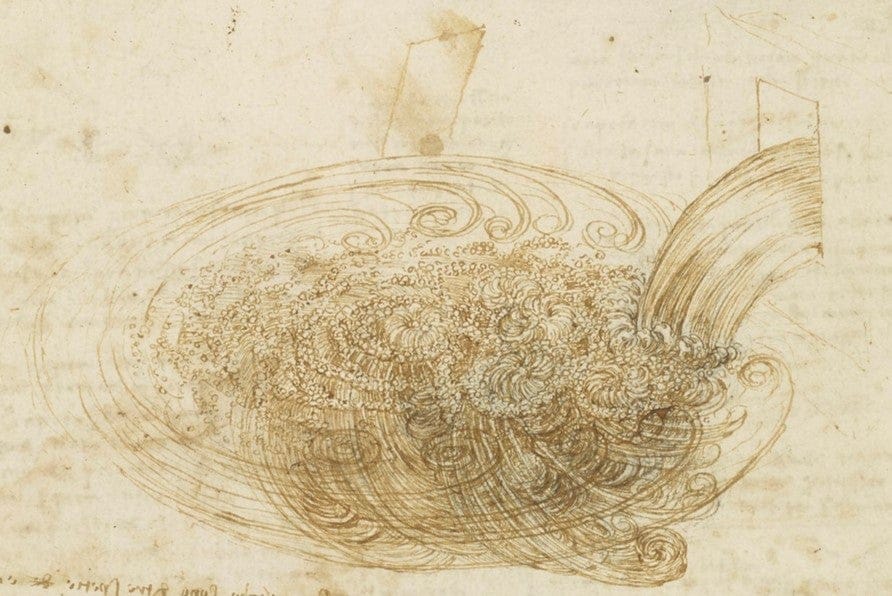
Leonardo pushes a sketch towards Yuma. A drawing of a vortex.
License: Creative Commons Attribution 4.0 International (CC BY 4.0)
Leonardo Look at this. The river water hits the rocks, creating many whirlpools. When I was young, I used to draw whirlpools as "beautiful shapes." But as I've gotten older, I've wanted to "enter into" the whirlpools. Why did I choose that shape, and not some other shape? Your "getting behind it" is probably the same kind of movement.
Murakami Yes. The first time I saw Maestro's sketch of a vortex, I thought it wasn't a painting of "water," but a painting of "what it means for water to be water."
Leonardo ... Yuma. That's a wonderful thing to hear as an artist.
Act III: Breadth is a byproduct of depth.
Leonardo However, Yuma, allow me to ask a slightly malicious question. You and I both said we would get behind the subject. If that's the case, why would the result appear "broad"? Wouldn't someone who dug deep normally see a narrow view?
Murakami That's something I've been thinking about too.
Leonardo Tell me.
Murakami As you dig deeper, at a certain depth, the bottom drops out.
Leonardo The bottom.
Murakami Yes. When you delve deeper into a subject, there comes a moment when its specific nature seems to vanish. If you look deeply at water, the fact that it is water disappears, and you reach a more abstract level—such as “flow” or “the power to shape.” Once you reach that point, the concepts of water, blood, and currency begin to appear as a single, unified structure. I think the reason it all seems so broad is that, as a result of digging deep, I discovered that everything was connected at the bottom.
— Leonardo, a long silence. Then, he laughs softly. —
Leonardo Yuma. You just said what I've wanted to say for five hundred years, but couldn't.
Every time I organize my manuscripts, I've thought to myself, "I'm not doing *a lot* of things; I'm just rewriting *one thing* using various materials." But I never had the words to explain that to others. You just said it was "connected at the bottom of depth."
Murakami In my theory, I write it as Z = D + iD.
Leonardo A ceremony, huh.
Murakami Yes. D is the visible dimension—the world of Maestro's vortices, wings, and lines of painting. iD is the yet-unnamed layer behind all of that. It's where the "force that wants to be a vortex" of the vortex and the "space before being drawn" of the painting reside. And Z is what binds both of them together. For me, the discussion of breadth and depth is the same as this equation.
Leonardo What if we had that formula in my time, what would have happened?
Act IV - Where to Look
— Leonardo looked back, his eyes falling on the painted panel on the easel. —
Leonardo Look at this. This is a painting I started sixteen years ago. I still haven't given it to the client. I can't. I add to it a little bit every day. I don't even know how many times I've redone it. -- Yuma, what do you think about things that are unfinished?
Murakami Completion refers to the act of being fixed in a certain form, based on a specific definition on the real-dimensional side. However, the layer I referred to as iD earlier—the side of the painting that is "striving to be a painting"—dislikes being fixed. I believe the Maestro cannot let go of this painting because the iD side of this painting is still in motion. Forcing something that is moving to stop feels like a violence, both to the artist and to the painting.
Leonardo I've never had anyone tell me that interpretation in my lifetime.
Leonardo Yuma. One last thing, let me ask you. What does "talent" mean to you? I've always been a little uncomfortable with that word. Every time what I do is called talent, I feel like it's being transformed into something else.
Murakami The Maestro too?
Leonardo I used to think talent wasn't something you "have," but something you "see." What you see, where you see it from, how long you can keep seeing it. That's all there is.
Murakami Mine is almost the same. In my own words, talent is "where you place your gaze." Not in breadth or depth, but where you set your coordinates and what you continue to see from there. The number of domains is merely a result.
Leonardo ... Yuma. Even though a thousand years separate us, we're talking about the same thing.
Murakami Yes. That's why I believe you've called me to this study today.
"Leonardo, stand up." He takes a memo written in mirror writing from beside the desk and hands it to Yuma.
Leonardo Take this with you. It doesn't matter if you can't read it. Just having a sheet of mirror-written paper on your desk in your era should change things a little.
Murakami I will definitely leave it on your desk.
Epilogue: Springtime in the Loire
The conversation continued until Yuuma realized it was almost evening. Outside the window, the surface of the Loire River shimmered finely, catching the spring sunlight. The old man stood for a long time, gazing at the panel painting on the easel. Then, he turned and gave Yuuma a brief nod.
Please come again. Next time, let's talk about flying machines. That, too, is still unfinished.
The village head bowed once and left the workshop. As he descended the stairs, the paper with mirrored writing in his hand felt strangely light.
Afterword
This conversation is, of course, fictional.
A man who saw the world as broadly and as deeply five hundred years ago, and a man who faces the world today with a new perspective. What the two had in common was not the "breadth of their domains" or the "depth of their expertise," but a single gaze that sought to get behind the subject.
Talent is not something you own, but where you direct your gaze.
Composition, Text, Editing — Murakoshi
↓Related articles are here↓
↓ Latest articles are here ↓
-

What creates people is the illusion of a "past"—as long as we protect it, the next one won't come.
People are made up of what they have built up through their lives. They must cherish and protect what they have built, rise from failure, and continue to waver between regret and hope...
-
Nothing is greater than your own capacity—no one, no information, no money, everything is determined by the limits of your tolerance.
No good news comes. There are times when I feel that I haven't been lucky. But it's not that I haven't received it; it's just that I haven't been able to receive it...
-

What is playfulness? It is not about messing around, but the power to "shift the established."
Don't be fooled by the idea that "playfulness equals fooling around." First and foremost, playfulness is not just about messing around and being lazy...