

Pseudo-understanding ── cutting out only the parts you understand and convincing yourself

- And then there is the opposing practice known as "lodging"
- Quasi-understanding is the act of taking things out of context and convincing oneself they understand.
- ── As a result, what is lost?
- On the opposite side is the "yadori" (dwelling).
- -- Staying Points
- The age of AI where the importance of momentum is increasing—After the gap in intelligence is eliminated by AI, what remains in the end
- How to turn the benefits of ecosystems destroyed by AI to the side of those who benefit from them—and how to leave the other half behind
- The era in which AI will make individuals the most powerful—the reason we stopped looking for abilities that can't be matched by AI
- Frequently Asked Questions
── And the opposite method, known as "yadori"
Listen to complex discussions and summarize the key points. Write down famous quotes. Take them back as thinking techniques.
It feels like you've learned something. But nothing has changed. This state has a name. Pseudo-understanding.
Quasi-understanding is the act of taking things out of context and convincing oneself they understand.
The definition is as follows: The act of cutting out only the parts one can understand and convincing oneself when faced with information that has a high difficulty of comprehension.
Three things are happening: the avoidance of cognitive dissonance, the forced compression into familiar frames, and a defensive reaction of self-identity.
In other words, because the state of not knowing is uncomfortable, you transform it into a comprehensible form and settle on that. Once it is transformed, it is no longer the original thing.
── As a result, what is lost?
The opportunity for expanded thinking is lost. Disconnection from others deepens. Furthermore, you remain merely a gatherer of information, staying stuck in the present without growing.
Copying famous quotes, thinking techniques, summaries of key points. None of these are bad in themselves. However, if that is where it ends, I want to reaffirm that it is a symbolic act of pseudo-understanding.
On the opposite side is the "yadori" (dwelling).
Dwelling refers to sinking oneself, ego and all, into another person's context, sense of presence, and cognitive structure, and existing as that person. Also known as other-assimilation.
Experiencing it not as mere knowledge, but with a sense of immersion. That is the decisive difference.
── Lodging tips
Welcoming uncertainty. Grasping the whole as both a space and a person. Removing one's own thinking framework.
Observe, notice, and enter non-defensive cognition. From there, move to egolessness. The sequence is suspended animation, dwelling, attunement, and reboot.
This can also be said to be the traditional approach to ascetic training or learning something new. It is dangerous to immediately apply one's own interpretation when one understands nothing, so one silently practices what the master says. Even if there is dissatisfaction or discomfort at the time, one feels gratitude years later. And it dwells within the master, and one day it is projected back onto oneself in high resolution.
Whether in spiritual discipline, study, or sports, in everything, it all starts with imitation.
When you encounter something you don't understand, do you transform it into a familiar shape, or do you dive into it while still not understanding? This fork in the road determines your subsequent growth.
The moment something can be summarized, it fits into an already known framework. What cannot be summarized is the untouched territory of expectation.
↓If you'd like to learn more, check out "θ Corridor" now↓
↓Related articles are here↓
↓ Latest articles are here ↓
-
The age of AI where the importance of momentum is increasing—After the gap in intelligence is eliminated by AI, what remains in the end
This article examines what makes the difference in the AI era. In conclusion, it is said that "the part of the brain that is responsible for thinking and creating ideas..."
-
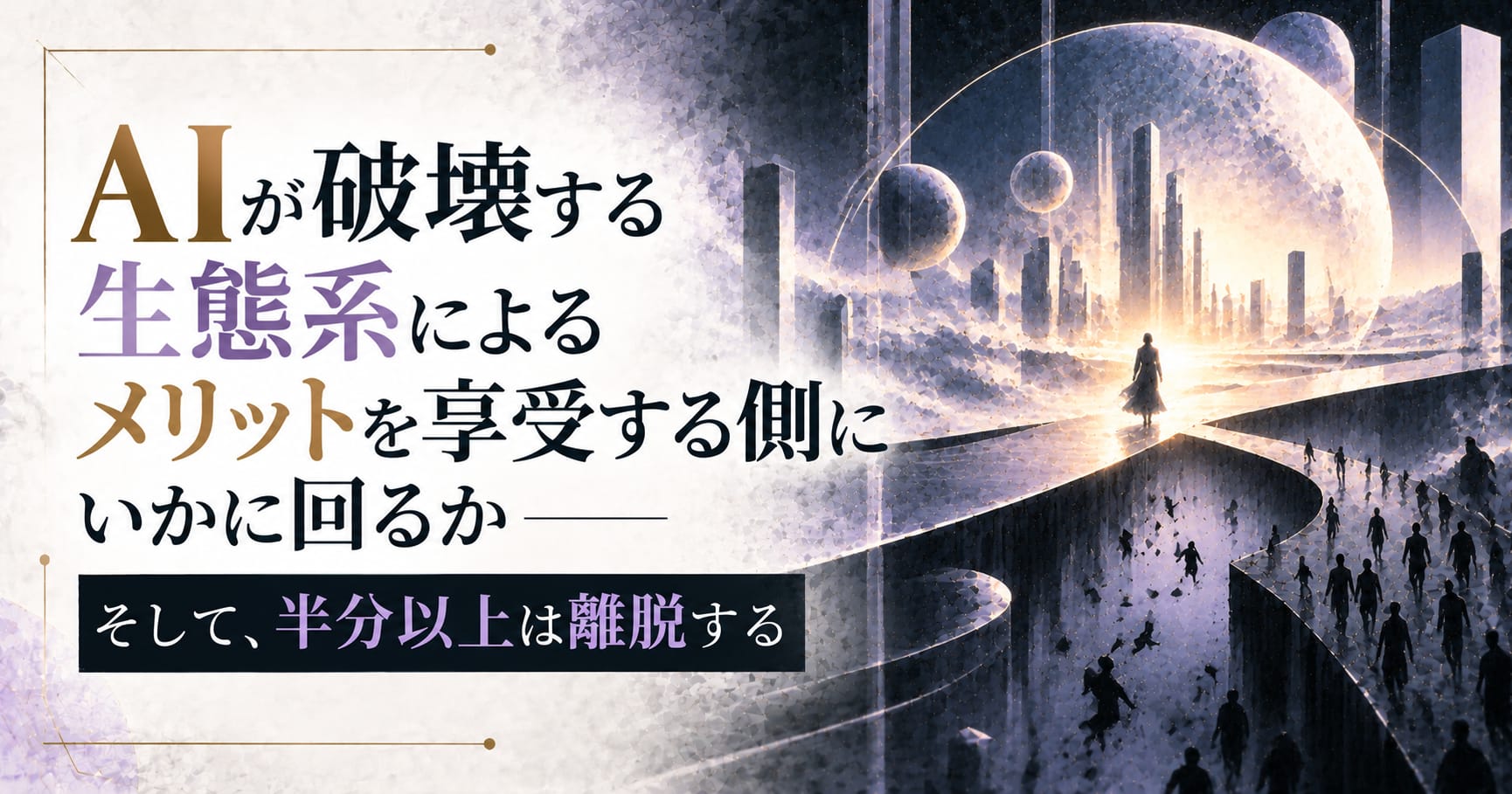
How to turn the benefits of ecosystems destroyed by AI to the side of those who benefit from them—and how to leave the other half behind
It is believed that businesses should start with what they want to do. However, the advent of AI is bringing a new wave to that. Sales…
-
The era in which AI will make individuals the most powerful—the reason we stopped looking for abilities that can't be matched by AI
Creating apps that only you use every day—replacing search or updating a handy tool for when you’re stuck—in an instant, now with AI…
Frequently Asked Questions
Among the difficult information, it’s about taking only the parts that you can understand and being satisfied with them.
It loses the opportunity to expand one’s thinking and new information that might have been included in the parts that are unclear.
A way of approaching things that leaves them within oneself without knowing what they are is helpful: the attitude of “accepting what you don’t know.”


