

The variable rate of life that does not correspond to the amount of reading—the only commonality among people who cannot change even after reading books

- Common to people who don't change even after reading books
- What is the difference between "vision" and "perspective"?
- Your starting point is invisible to yourself.
- When does a perspective change?
- For Those Who Want to Learn More
- The age of AI where the importance of momentum is increasing—After the gap in intelligence is eliminated by AI, what remains in the end
- How to turn the benefits of ecosystems destroyed by AI to the side of those who benefit from them—and how to leave the other half behind
- The era in which AI will make individuals the most powerful—the reason we stopped looking for abilities that can't be matched by AI
- Frequently Asked Questions
Common to people who don't change even after reading books
People who read a hundred books a year still struggle with the same problems even after a decade. It’s not an uncommon phenomenon.
For example, imagine a person who is struggling because they can’t trust people at work has read dozens of books on communication. The skills of communication will become ingrained and they will be able to have better conversations than before. However, as long as the premise that “people will ultimately betray you” remains deep and ingrained, any technique will be used towards the same conclusion.
Knowledge is increasing, and so are vocabulary and the range of topics. Yet the problem remains unchanged because what has increased is only the material for the answers, and the foundation for assembling them remains the same as before.
What is the difference between "vision" and "perspective"?
Expanding your perspective means increasing the scope of your vision and being able to see things from a distance. People who were only able to see the gains and losses of today will be able to see things from a perspective that extends beyond five years. They will be able to judge things not only based on profit and loss but also based on beauty.
This includes being able to break down evaluations into smaller parts and being able to question how far one’s own standards apply.
The other perspective refers to the "starting point" that the measuring rod is placed at. No matter how many measuring rods are added, if the starting point remains the same, the view from that location remains the same.
Your starting point is invisible to yourself.
The position of the zero on the ruler cannot be determined by the measured numbers. The same applies to human judgment; the premise of "what is important" is not consciously considered while making a judgment.
Some people keep changing jobs and quit for the same reason over and over again. Although the environment changes every time, the starting point for measuring the environment doesn’t change, so the results will always repeat themselves.
When does a perspective change?
The tricky thing is that it’s difficult to move the starting point by thinking about it. That’s because the act of thinking itself is being performed at that starting point.
The real triggers for shifting perspective are most often things that happen outside of the mind: when we lose something important, when we live in a land where language is not understood, or when the sense of “self” softens slightly in the midst of silence. Of course, not everyone is changed by such events. There are clear criteria that distinguish those who change and those who do not.
Reading books gives you a broader view of the world.
Furthermore, when I realize where I am standing and what I am reading, the same book begins to seem like a completely different book.
For Those Who Want to Learn More
The background to this article is a paper that re-frames the perspective from the three elements of "range, orthogonality, and origin," and distinguishes the expansion of the field of view and the change in the perspective as separate events. The conditions under which the perspective changes and the factors that prevent the change from being continued in the middle are also discussed in detail.
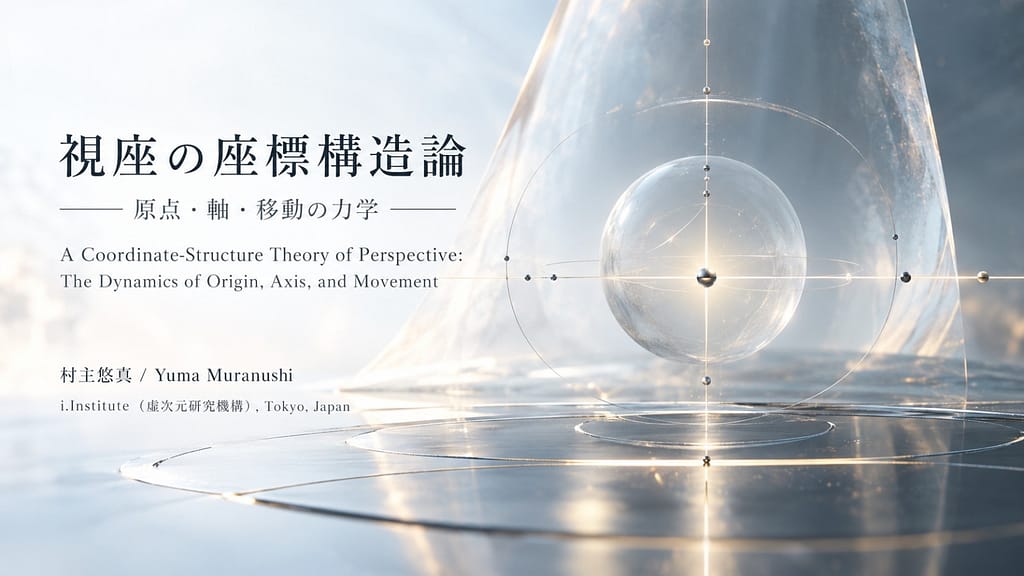
Murashu Yuuma (2026) "Coordinate structure theory of vision" ── "The Mechanics of Origin, Axis, and Motion"
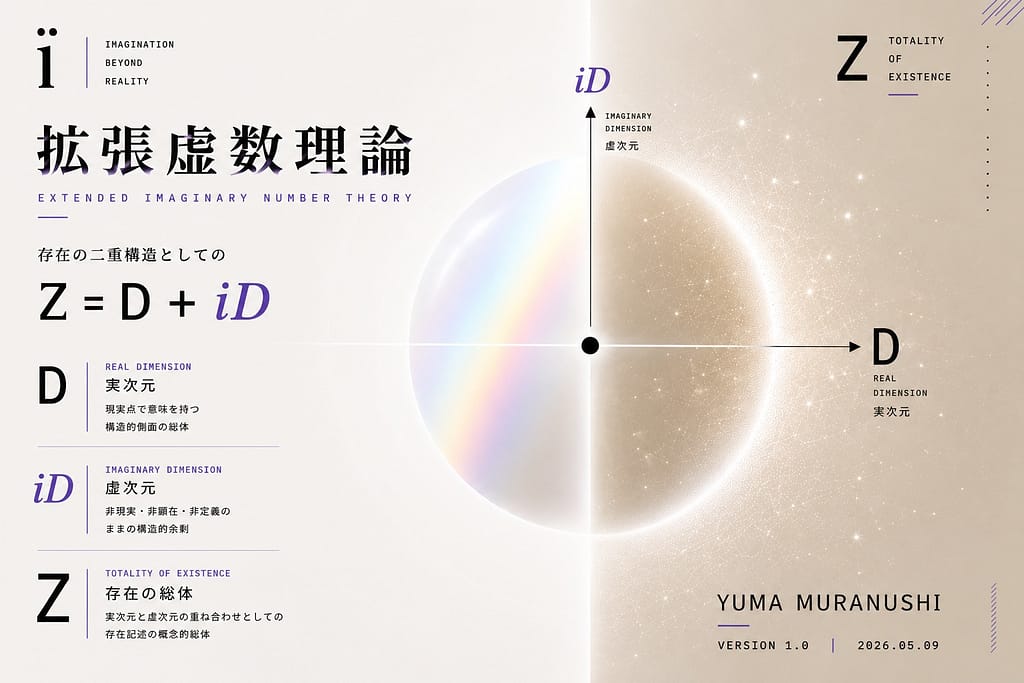
Murashu Yuuma (2026) "Extended Abstraction Theory: As a Double Structure of Existence"Z = D + ID』
↓For those who want to know more, check out "θ-galleries" now↓
↓Related articles are here↓
↓ Latest articles are here ↓
-

The age of AI where the importance of momentum is increasing—After the gap in intelligence is eliminated by AI, what remains in the end
This article examines what makes the difference in the AI era. In conclusion, it is said that "the part of the brain that is responsible for thinking and creating ideas..."
-

How to turn the benefits of ecosystems destroyed by AI to the side of those who benefit from them—and how to leave the other half behind
It is believed that businesses should start with what they want to do. However, the advent of AI is bringing a new wave to that. Sales…
-

The era in which AI will make individuals the most powerful—the reason we stopped looking for abilities that can't be matched by AI
Creating apps that only you use every day—replacing search or updating a handy tool for when you’re stuck—in an instant, now with AI…
Frequently Asked Questions
What is increasing is only the "material of the answer," because the foundation for assembling it—that is, the perspective—is in the same place.
Field of view refers to the width of the visible range; a visual axis is the starting point from which we view that world.
Because our starting point is difficult to see with our own eyes, our perspective changes with experiences that shake our assumptions and with encounters with people with different starting points.


