

The reason things don't last is not because of a weak will, but because of the depth at which the resolution was placed.

- Some things are kept up by the same people.
- There are five depths of determination.
- A quitter is going back and forth on the first step.
- The depth of restriction and the depth of immersion go hand in hand.
- The question is not what to do
- For Those Who Want to Learn More
- The age of AI where the importance of momentum is increasing—After the gap in intelligence is eliminated by AI, what remains in the end
- How to turn the benefits of ecosystems destroyed by AI to the side of those who benefit from them—and how to leave the other half behind
- The era in which AI will make individuals the most powerful—the reason we stopped looking for abilities that can't be matched by AI
- Frequently Asked Questions
Some things are kept up by the same people.
I decided to wake up early. I decided to exercise. I quit after three days and blamed myself.
Yet that same person has been brushing their teeth for years. Nobody does it by willpower.
The difference lies not in a person's own strength, but in what supports their actions.
There are five depths of determination.
First, a declaration. You say out loud what you are going to do this year. It is the most superficial level. It is merely a statement placed outside of action, supported only by willpower, so it collapses on days when your willpower weakens.
Second, procedure. Change the actual method itself to align with your determination. Because it reduces the number of decisions you have to make, it lasts longer than a simple declaration.
Third, mechanisms. Embedding them on the side of tools and the environment. The resolution not to bring a smartphone into the bedroom is practically finalized the moment you place the charger in the living room. At this point, willpower is not used.
Fourth, operation. Do not make the resolve monolithic, but divide it into layers. Temporarily remove it only when necessary, while maintaining the other layers. It becomes a system where you can design revocation and retention, rather than prohibitions.
Fifth, principle. Abstract this into the general rule of not doing more than necessary, making it work without the need for individual judgments.
From shallow to deep, the same resolve shifts. The higher you go, the less need there is for willpower.
A quitter is going back and forth on the first step.
Make a new resolution. It holds for a few days by willpower. Get tired. Fall apart. Blame myself. Make a new resolution again.
No matter how many times you do it within this loop, it is only placed at the same depth.
What is needed is not a stronger resolve. It is the work of moving that same resolve to a deeper level.
If you want to exercise, don't make a declaration; put your workout clothes by the front door. If you decide not to look at something, don't rely on willpower; delete the app. If you want to write every day, don't rely on motivation; schedule the time just like any other appointment.
You don't need to change the content of your resolution. Just change where you put it.
The depth of restriction and the depth of immersion go hand in hand.
I want to reverse it here. Restrictions are not meant to define where you cannot go. They provide the structure necessary to step in.
Throughout the six papers in the Extended Imaginary Number Theory series, a single restriction has been maintained: "not describing the imaginary dimension itself directly." However, its placement has changed every time: from declaration to method, into the interior of the formal apparatus, to operation, and finally to principle.
What is noteworthy is the parallel relationship. The more perilous the territory being stepped into, the deeper the level at which the restrictions are built in. Because there is support deep down, one can go right up to the edge of it.
It's not that the rope was shortened. Rather, the rope was re-driven into a spot from which it won't slip out.
The reporters who dig deeper into their interviews have the verification process ingrained in them. The investors who move large amounts of money have their stop-loss criteria built into the mechanics rather than leaving it to judgment. The people who seem the freest have driven stakes into places you cannot see.
The question is not what to do
At what depth must this determination be kept?
Is a declaration enough? Should we change the procedure? Embed it in the system? Divide it into layers? Or delegate the judgment itself to a principle?
You don't need to strengthen your willpower. You just need to lower your resolution to a place where willpower is no longer required.
For Those Who Want to Learn More
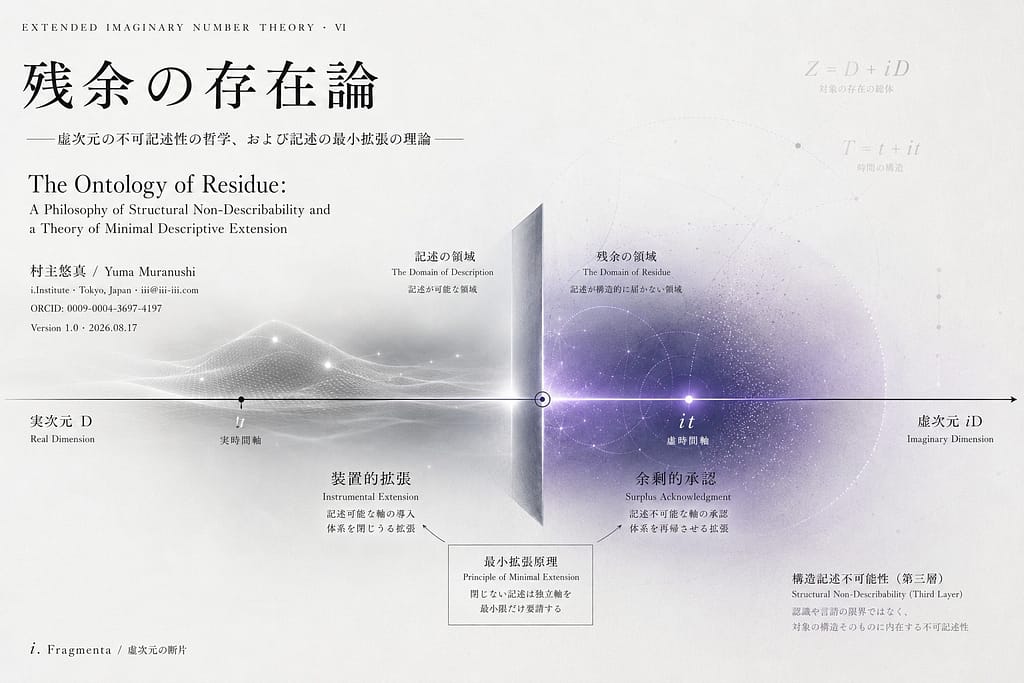
The analysis of how self-limitation accumulates through five stages and functions not as a passive brake, but as a condition enabling a step into deeper realms, can be found in the sixth paper of the Extended Imaginary Number Theory series.
↓Click here for *The Ontology of the Residual: A Philosophy of the Indescribability of the Imaginary Dimension and a Theory of the Minimal Extension of Description* (Yuma Murashu, 2026)↓
The final principle of the five stages—the norm of not introducing axes more than necessary—is formulated in the fifth paper.
↓Click here for "Imaginary Time: The Non-Closure of Description and the Principle of Minimal Extension" (Yuma Murasugi, 2026)↓

↓Related articles are here↓
↓ Latest articles are here ↓
-

The age of AI where the importance of momentum is increasing—After the gap in intelligence is eliminated by AI, what remains in the end
This article examines what makes the difference in the AI era. In conclusion, it is said that "the part of the brain that is responsible for thinking and creating ideas..."
-

How to turn the benefits of ecosystems destroyed by AI to the side of those who benefit from them—and how to leave the other half behind
It is believed that businesses should start with what they want to do. However, the advent of AI is bringing a new wave to that. Sales…
-

The era in which AI will make individuals the most powerful—the reason we stopped looking for abilities that can't be matched by AI
Creating apps that only you use every day—replacing search or updating a handy tool for when you’re stuck—in an instant, now with AI…
Frequently Asked Questions
No. Whether it continues depends not on the strength of the will but on the depth of the determination.
It consists of five stages: declaration, procedure, mechanism, operation, and principle. The deeper you go, the more you can continue without using the power of will.
Rather than repeating the declaration, it is about embedding the determination in the procedures and mechanisms of the environment.


