
Beyond the Difference Between "Intuition" and "Flash of Insight" — The Story of How Action Precedes Awareness

- What is the difference between the two?
- Active thinking and its inversion
- "Occurrence" as a structural phenomenon
- Thinking is not just about retrieving information.
- A mindset of receiving
- What creates people is the illusion of a "past"—as long as we protect it, the next one won't come.
- Nothing is greater than your own capacity—no one, no information, no money, everything is determined by the limits of your tolerance.
- What is playfulness? It is not about messing around, but the power to "shift the established."
What is the difference between the two?
In the context of neuroscience, the difference between "intuition" and "inspiration" is organized as follows:
Inspiration is a function of the cerebral cortex, and one can explain the reasons after coming up with it. Intuition is a function of the striatum, and one can vaguely feel convinced without knowing the reason.
Of course, this is a scientifically sound organization from a neuroscience perspective, but as long as we talk about this difference as a difference in brain regions, we will miss more important commonalities.
What both parties have in common is that awareness does not precede action.
Active thinking and its inversion
Something is already completed before the subject turns its attention to it.
Under normal active thinking, the order is as follows.
The subject directs its intention towards "thinking about this." The object then appears in response to that intention. The intention precedes the apprehension of the object.
However, in intuition and flashes of insight, this order is reversed.
Before the subject consciously directs its intention to "think of this," something is already emerging. And after the emergence is complete, one realizes, "this was emerging." Awareness is not the beginning of emergence, but a retrospective cognition of its completion.
"Occurrence" as a structural phenomenon
Intuition and inspiration are merely different manifestations of the same phenomenon.
This ex post facto structure is not just about intuition and inspiration.
The answer to a long-pondered problem suddenly comes to me while I'm doing something else. An unexpected word pops into my head mid-sentence. A direction I was struggling with becomes clear without me realizing it.
What is happening in these situations is all the same structure. The setup occurs first, and awareness recognizes it later.
This structural phenomenon is called an "occurrence." Intuition and inspiration can be positioned as different manifestations of occurrences.
Thinking is not just about retrieving information.
The moment it loosened, it came from the other side.
What happens teaches us something important. It is that not all thinking is active retrieval.
We think of thinking as "taking things out." That's why we try to "think harder" or "concentrate more."
However, many truly decisive insights do not result from active retrieval. They arrive from the other side the moment we relax our posture of trying to retrieve them.
Many experiences where you feel you've "come up with an answer after deep thought" might actually just be a case of "a solution being completed elsewhere while you were thinking."
A mindset of receiving
Receive what has arrived.
When discussing the difference between intuition and inspiration, neuroscience categorizes both as "different ways of coming up with ideas."
However, phenomenologically speaking, there is a deeper common structure to both. It is a structure where something is already completed prior to the subject's activity.
Thinking is not just about taking things out.
To receive what has arrived is also to accept it.
Intuition and inspiration are merely different manifestations of how they are received.
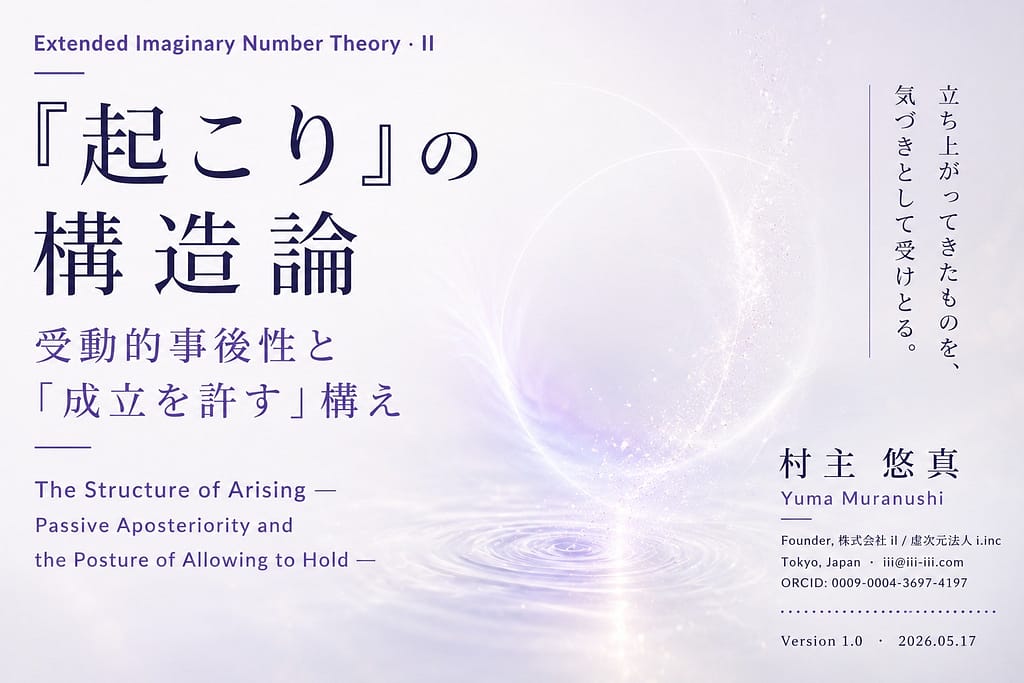
↓Murakami's Second Paper, "A Structural Theory of Origins," is here↓
↓Related articles are here↓
↓ Latest articles are here ↓
-

What creates people is the illusion of a "past"—as long as we protect it, the next one won't come.
People are made up of what they have built up through their lives. They must cherish and protect what they have built, rise from failure, and continue to waver between regret and hope...
-
Nothing is greater than your own capacity—no one, no information, no money, everything is determined by the limits of your tolerance.
No good news comes. There are times when I feel that I haven't been lucky. But it's not that I haven't received it; it's just that I haven't been able to receive it...
-

What is playfulness? It is not about messing around, but the power to "shift the established."
Don't be fooled by the idea that "playfulness equals fooling around." First and foremost, playfulness is not just about messing around and being lazy...