
What is the difference between "Mu" and "Ku" - Understanding Eastern Philosophy through Lao Tzu, Buddhism, and the Void Dimension
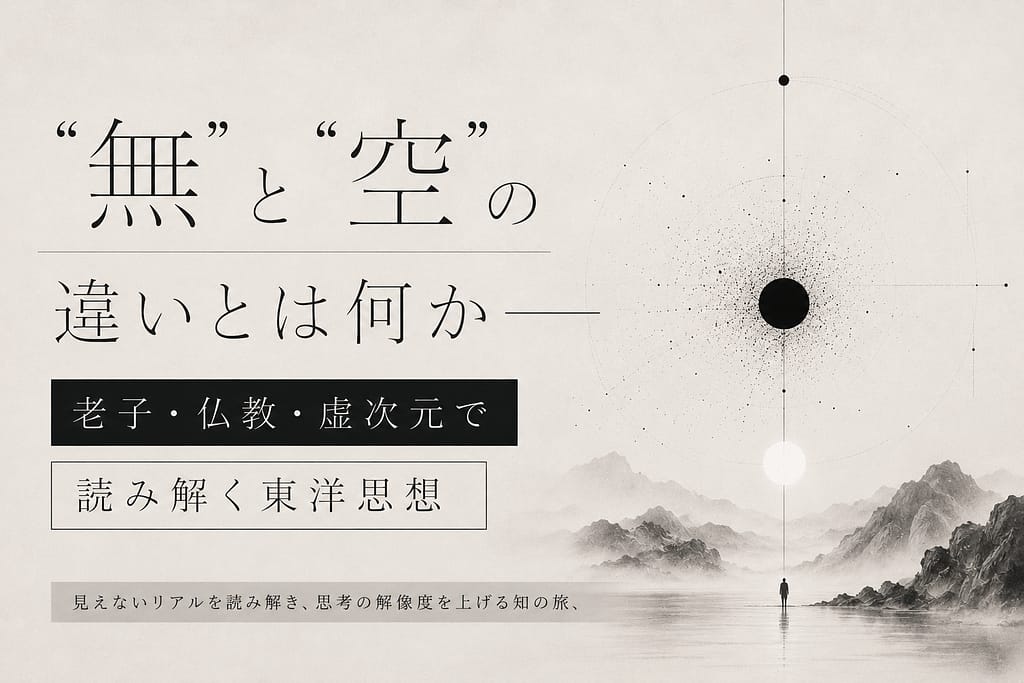
「無" and "EmptinessAre they the same or different?
Anyone who has ever touched upon explanations of Buddhism and Taoism must have been confused at some point. In fact, disputes surrounding the two have been repeated throughout the history of Buddhism.
And both of them Difference When clearly organized, it connects to unexpected places. That is,virtual dimension is a modern concept.
- "Nothingness" is not a lack.
- The emptiness that Lao Tzu saw in the hub of the wheel, producing.
- Nagarjuna's Madhyamaka: Provisionally Standing Within Dependent Origination
- Meanwhile, "emptiness (śūnyatā)" in Buddhism is another concept entirely.
- Where is the virtual dimension located?
- The description "iD" — toward before "Yu" stands up
- Difference from "Sky" layer
- Propositions of existence and the concept of descriptive structure
- Not wishing for world peace, but increasing practitioners who implement it: What lies between prayer and implementation
- Afghanistan Stay Journal Day 1: Hotels, Food, and Safety
- Now that AI is destroying the ecosystem, where do we stand? Vapors are being born in order.
"Nothingness" is not a lack.
The emptiness that Lao Tzu saw in the hub of the wheel, producing.
In Daoist thought, "wu" (nothingness) does not simply mean "the absence of things."
There is a passage in Chapter 11 of the *Tao Te Ching* that reads:
Thirty spokes unite into one hub. It is the emptiness at the center of the hub that makes the wheel useful. Clay is kneaded to make a vessel. It is the emptiness inside the vessel that makes it useful.
Here, "nothingness" is positioned as the condition that makes "somethingness" possible. A vessel functions as a vessel because there is "nothingness" inside it.
"Nothingness" is not merely an absence. It is Productive nothingness as described.
"Emptiness" is the negation of substantiality.
Nagarjuna's Madhyamaka: Provisionally Standing Within Dependent Origination
Meanwhile, "emptiness (śūnyatā)" in Buddhism is another concept entirely.
"Emptiness" in the *Prajnaparamita Sutras* and by Nagarjuna's Madhyamaka school refers to all phenomena Denial of substantiality This implies that all things are devoid of inherent existence and are only provisionally established in dependent origination. This is what "form is emptiness, emptiness is form" expresses.
In short, the difference between "nothingness" and "emptiness" can be summarized as follows.
The Taoist concept of "wu" isThe source that gives birth to life It is positioned as the "nothingness" that exists before the world was born, or as the condition that makes "being" possible.
Buddhism's "emptiness" is...Denial of the substantiality of things asserts. The proposition is that things do not simply "not exist," but rather provisionally exist within dependent origination without possessing a fixed essence.
The two are similar, but at different layers. "Nothingness" is part of the drama of cosmic creation, while "emptiness" is a total proposition about the mode of existence of things.
Where is the virtual dimension located?
The description "iD" — toward before "Yu" stands up
Here, the concept of a虚次元 appears.
What Muranushi calls 'iD' in extended imaginary theory occupies a functionally analogous position to the Taoist concept of 'Wu' (nothingness). Both represent the established meaning—D or 'Yu' (to have)... Before The fact that it is located in and can be positioned as a turning point that enables its rise is similar.
Difference from "Sky" layer
Propositions of existence and the concept of descriptive structure
The Buddhist concept of "emptiness" (空) is on a different layer than the void dimension.
"Sky" is a thing Mode of existence while the proposition is about, the imaginary dimension is of things Descriptive structure It's a concept about. Both are not discussed on the same level.
Then why write these intersections?
The originality of the theory of virtual dimensions doesn't lie in the discovery of new concepts. Instead, it lies in integrating the "unarticulated domains" that Taoism, Buddhism, phenomenology, structuralism, cognitive science, and machine learning have each dealt with individually, under a single structural description of Z = D + iD.
"Nothingness," "emptiness," and "void dimension" are not the same.But humanity has long been in contact with Nearby area This is an attempt to establish the coordinates of vocabulary with a new concept.
And the imaginary dimension is what takes on that attempt again with modern structural description.
↓Murakumo's first thesis "Extended Imaginary Theory" is here↓
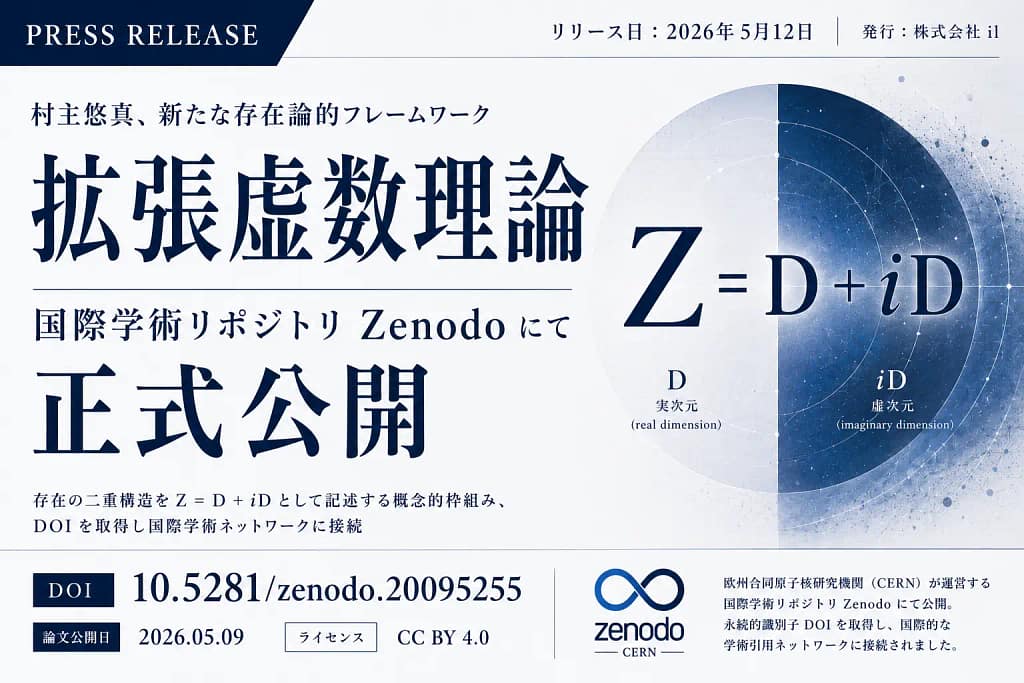
↓Related articles are here↓
↓Latest posts are here↓
-

Not wishing for world peace, but increasing practitioners who implement it: What lies between prayer and implementation
Wishes do not change their structure even if the total amount increases. Even if the number of people wishing for peace doubles, the distribution of resources remains unchanged. Wishes are completed within the individual...
-

Afghanistan Stay Journal Day 1: Hotels, Food, and Safety
I am in Afghanistan. Japan still designates it as a travel-ban area, so the hurdles are quite high, but...
-

Now that AI is destroying the ecosystem, where do we stand? Vapors are being born in order.
The list of "jobs that will disappear" is useless. Job titles are merely loose bundles of work content. What actually disappears are the jobs...