

"Letting go of attachment" - What are we letting go of? A structural perspective, distinct from Buddhist liberation.

「Letting go of attachmentThe phrase " " is repeated in self-help settings.
In Buddhism, it's called "Self-attachment (gashu)," in psychology, "excessive attachment," and in behavioral economics, the "sunk cost effect" -- though the approaches differ, the recognition that attachment breeds suffering is common across various fields.
However, something strange happens here.
The more you consciously try to let go of attachment, the stronger the attachment becomes.。
This paradox offers an entry point to seeing the true structure of obsession.
- The root of attachment from a Buddhist perspective
- The Scope of Psychology and Behavioral Economics
- The true nature of attachment as a structure
- Transformation beyond willpower
- When the subject that is attached to fades
- The age of AI where the importance of momentum is increasing—After the gap in intelligence is eliminated by AI, what remains in the end
- How to turn the benefits of ecosystems destroyed by AI to the side of those who benefit from them—and how to leave the other half behind
- The era in which AI will make individuals the most powerful—the reason we stopped looking for abilities that can't be matched by AI
- Frequently Asked Questions
The root of attachment from a Buddhist perspective
The root of attachment in Buddhism is The illusion of "self" It is said that this is present. The fixed self, the unchanging self, the self to be protected. Because this "I" arises, attachment to protect it is born.
The Heart Sutra's teaching of "form is emptiness" and Nagarjuna's argument for "non-self-nature" are intended to demonstrate that this "self" does not exist as a substantial entity.
Letting go of attachment fundamentally means letting go of "yourself who is attached." It is precisely
This is a deep insight. However, it's difficult to practice a Buddhist approach as is in modern times.
The Scope of Psychology and Behavioral Economics
In psychology, attachment is analyzed from another angle.
Psychiatrist Adler understood attachment as "over-reliance on a sense of belonging." Behavioral economics describes this as the sunk cost fallacy.
These also capture one side of the truth. However, both The surface of attachment is only dealing with.
Because even if you can "let go of attachment" with a psychological and behavioral economics approach, the moment you let go My former self, free from attachment Because a new obsession will be born.
The true nature of attachment as a structure
Here is the true structure of obsession.
Attachment does not simply indicate attachment to a specific object。
That is,The movement to maintain "myself who is attached to something" That's it.
Even if the object changes, the structure remains. Someone who lets go of attachment to things will turn to attachment to people. Someone who lets go of attachment to people will turn to attachment to enlightenment.
Even if the object of attachment changes, if the subject of attachment itself remains, attachment will be reproduced in another form.
Zen is "If you meet the Buddha, kill the Buddha.This is a warning about recursiveness.
You must let go of even the last attachment, the attachment to "the enlightened self."
Transformation beyond willpower
So, what is needed? It's not an effort to change the target.
The very structure of "myself being fixated" fades away.This is a different situation.
This cannot be achieved through willpower. If you decide to "let go of attachment," that very decision becomes a new attachment.
What's needed is a different structure ── Towards the weakening of the egoIt's a structural transformation.
And when the ego diminishes, it does not mean that the self disappears.
A structure that moves in sync with the flow of the world to become.
There, there is no longer a distinction between "that which is clung to" and "the object of clinging." In a place where there is no distinction, clinging cannot be structurally established.
When the subject that is attached to fades
Letting go of attachments is not about crossing things off a list.
That is,The subject of attachment itself is structurally diluted. It's an event from another dimension.
Buddhism once spoke, but its vocabulary is difficult to fit into modern structural descriptions.
Vocabulary that bridges both is needed once again.
↓For more details, check out Theta Corridor III "Origin and Transparency" now↓
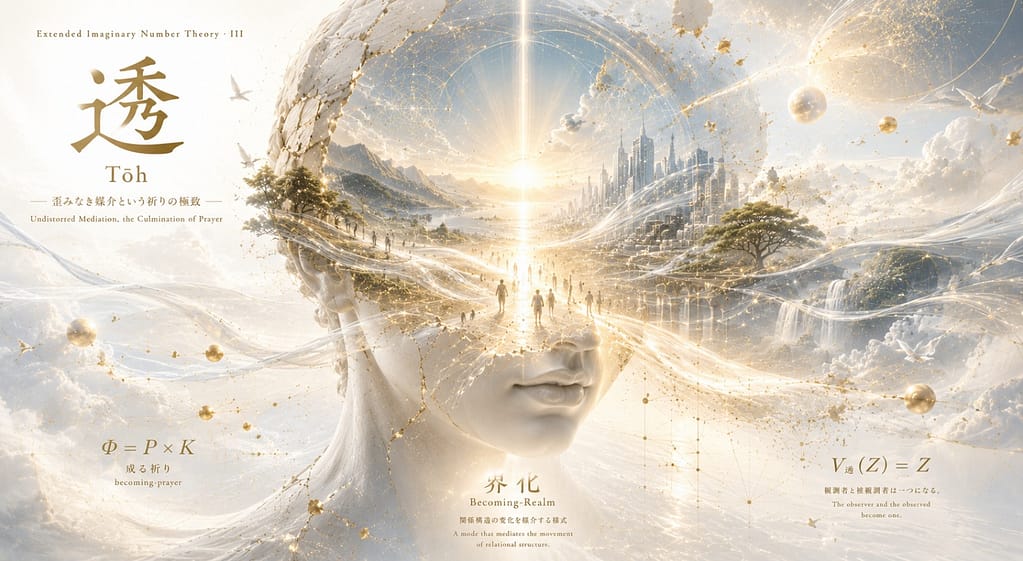
↓Murakami's Third Thesis, "Pure and Unblemished Mediation: The Pinnacle of Prayer," is here↓
↓Related articles are here↓
↓ Latest articles are here ↓
-
The age of AI where the importance of momentum is increasing—After the gap in intelligence is eliminated by AI, what remains in the end
This article examines what makes the difference in the AI era. In conclusion, it is said that "the part of the brain that is responsible for thinking and creating ideas..."
-

How to turn the benefits of ecosystems destroyed by AI to the side of those who benefit from them—and how to leave the other half behind
It is believed that businesses should start with what they want to do. However, the advent of AI is bringing a new wave to that. Sales…
-
The era in which AI will make individuals the most powerful—the reason we stopped looking for abilities that can't be matched by AI
Creating apps that only you use every day—replacing search or updating a handy tool for when you’re stuck—in an instant, now with AI…
Frequently Asked Questions
It’s not about letting go of the object; it’s about the “attachment” to oneself itself fading away.
The very act of consciously “letting go” strengthens the entity that clings on.
I believe that attachment arises from the belief that there is a fixed "me," and I argue that this "me" has no real existence.


