

The limits of knowledge are not a matter of ability—five principles embedded in the structure of cognition

Someday, the day will come when you know everything.
It is the wish of many and the ambition of mankind. However,The limits of knowledge This is not about the limits of human capabilities.
That is The structure of the act of description itself It is an embedded fact.
This is shown by the five principles that support the extended imaginary theory.
- Principle 1: Never close any statement.
- Principle 2: What is left behind is inside the object.
- Principle 3: Quantitative expansion never reaches the imaginary dimension.
- Principle 4: A complete description is impossible at any subject or time.
- Principle 5: Boundaries are fluid, but the void is inexhaustible.
- The acquisition of a new D simultaneously opens up new horizons for iD.
- The age of AI where the importance of momentum is increasing—After the gap in intelligence is eliminated by AI, what remains in the end
- How to turn the benefits of ecosystems destroyed by AI to the side of those who benefit from them—and how to leave the other half behind
- The era in which AI will make individuals the most powerful—the reason we stopped looking for abilities that can't be matched by AI
- Frequently Asked Questions
Principle 1: Never close any statement.
For any given object, its fractal dimension D does not, by itself, constitute a closed description. Put simply, "no matter how precisely you describe it, you can never fully capture the object."
Suppose you have meticulously written a biography of a certain person spanning ten volumes. Even then, we would never say, "Everything about this person has been written." Something is always left behind. And that which is left behind is not the kind of thing that can be entirely captured through effort.Structurally left behind is.
Principle 2: What is left behind is inside the object.
When you hear, "There's something that hasn't been grasped," people unconsciously imagine the outside of the object. However, the virtual dimension is an unsegmented layer folded within the object. If it were on the outside, it would become "another object."
Principle 3: Quantitative expansion never reaches the imaginary dimension.
If we quantitatively expand D, will we eventually reach iD? The answer is a definite no.
No matter how much you refine observations, subdivide concepts, and elaborate classifications, you are merely expanding the domain of meaning quantitatively. You will never reach the realm before meaning formation. The two do not exist on a continuous, contiguous plain.
Principle 4: A complete description is impossible at any subject or time.
Even if you gather researchers from around the world, multiply human intelligence a hundredfold, or delegate tasks to AI, the situation will not change. Descriptions are approximate, partial, and provisional. This is a structural characteristic of the act of description itself.
Here, a certain kind of humility is structurally built-in. Not an empirical humility of "we still don't know much," but rather...Our descriptions are not closed in principle.is structural humility.
Principle 5: Boundaries are fluid, but the void is inexhaustible.
At one point, a structure that was in the imaginary dimension came to be classified in the real dimension due to the advancement of cognition. The concept of probability was like that.
However—and this is important—this movement does not mean the depletion of the void dimension. With the establishment of the axis of probability, new horizons of the void dimension were simultaneously opened. Questions like "How are subjective probability and objective probability related?" can only arise after the concept of probability itself has been established.
The acquisition of a new D simultaneously opens up new horizons for iD.。
The most practical implication derived from this is Dual responsibility for description That's right.
The person describing a subject bears two responsibilities simultaneously. First, to describe the structure as it is perceived at the present moment, with as much accuracy as possible. Second, to explicitly acknowledge and reserve that the description is never closed.
The latter feels that the former has been completed. That moment The most forgettable. The sense of accomplishment that says, "Now I've captured the subject," is structurally always a mistake.
The limits of knowledge are not due to a lack of effort.Only those who know that can continue to write sincerely.
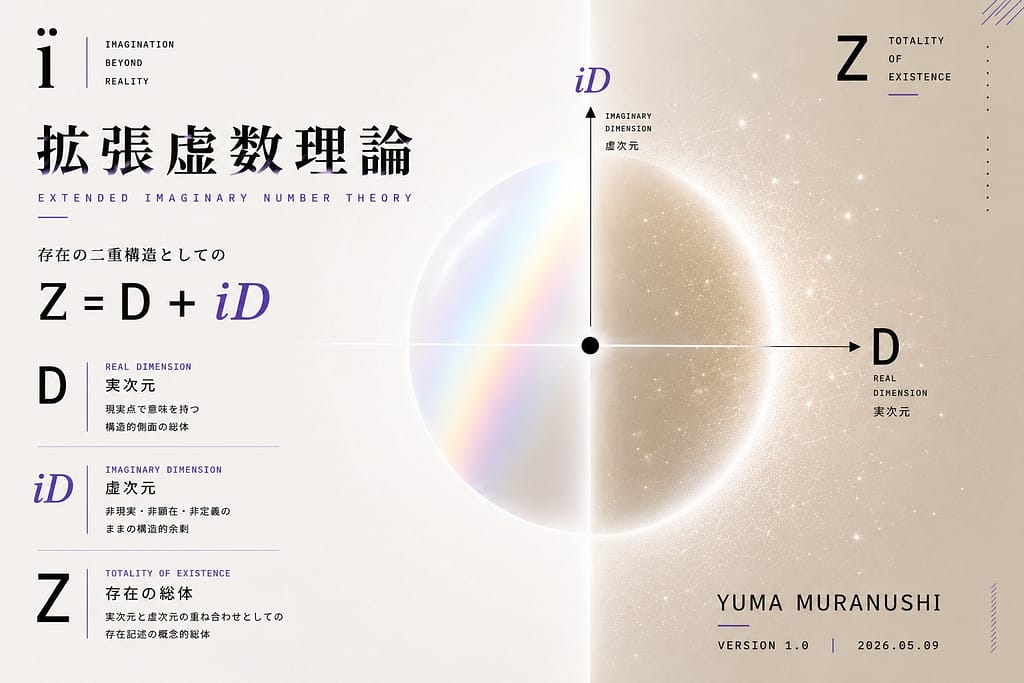
↓Murakumo's first thesis "Extended Imaginary Theory" is here↓
↓Related articles are here↓
↓ Latest articles are here ↓
-
The age of AI where the importance of momentum is increasing—After the gap in intelligence is eliminated by AI, what remains in the end
This article examines what makes the difference in the AI era. In conclusion, it is said that "the part of the brain that is responsible for thinking and creating ideas..."
-

How to turn the benefits of ecosystems destroyed by AI to the side of those who benefit from them—and how to leave the other half behind
It is believed that businesses should start with what they want to do. However, the advent of AI is bringing a new wave to that. Sales…
-

The era in which AI will make individuals the most powerful—the reason we stopped looking for abilities that can't be matched by AI
Creating apps that only you use every day—replacing search or updating a handy tool for when you’re stuck—in an instant, now with AI…
Frequently Asked Questions
It is the practice of describing and capturing an object through words or concepts. However, no matter how precisely it is described, it cannot encompass everything.
No. Due to the limitations built into the very structure of the act of writing, the amount of effort involved is not enough to fill it.
No. Because every time you gain new knowledge, a new unknown horizon opens up at the same time.


