
To those who cannot see, the unseen remains unseen—The viewpoint of a void-dimensional ability user and the structural limits of perception.
There's an experience of "not knowing why I don't understand."
What is obvious to me is not at all apparent to the other person. Even when I explain it, they don't understand. Even when I show them the structure, it doesn't get through.
Irritation sets in, or resignation. You come to the conclusion, "I can't get through to this person."
But I want you to stop and think. This isn't a matter of the other person's ability. It's a matter of perspective. And my past self probably couldn't see it the same way either.
- Those who cannot see do not know they cannot see.
- No statement ever closes.
- The height of perspective is sensitivity to the breadth of id.
- Those who possess virtual dimension abilities do not fear silence.
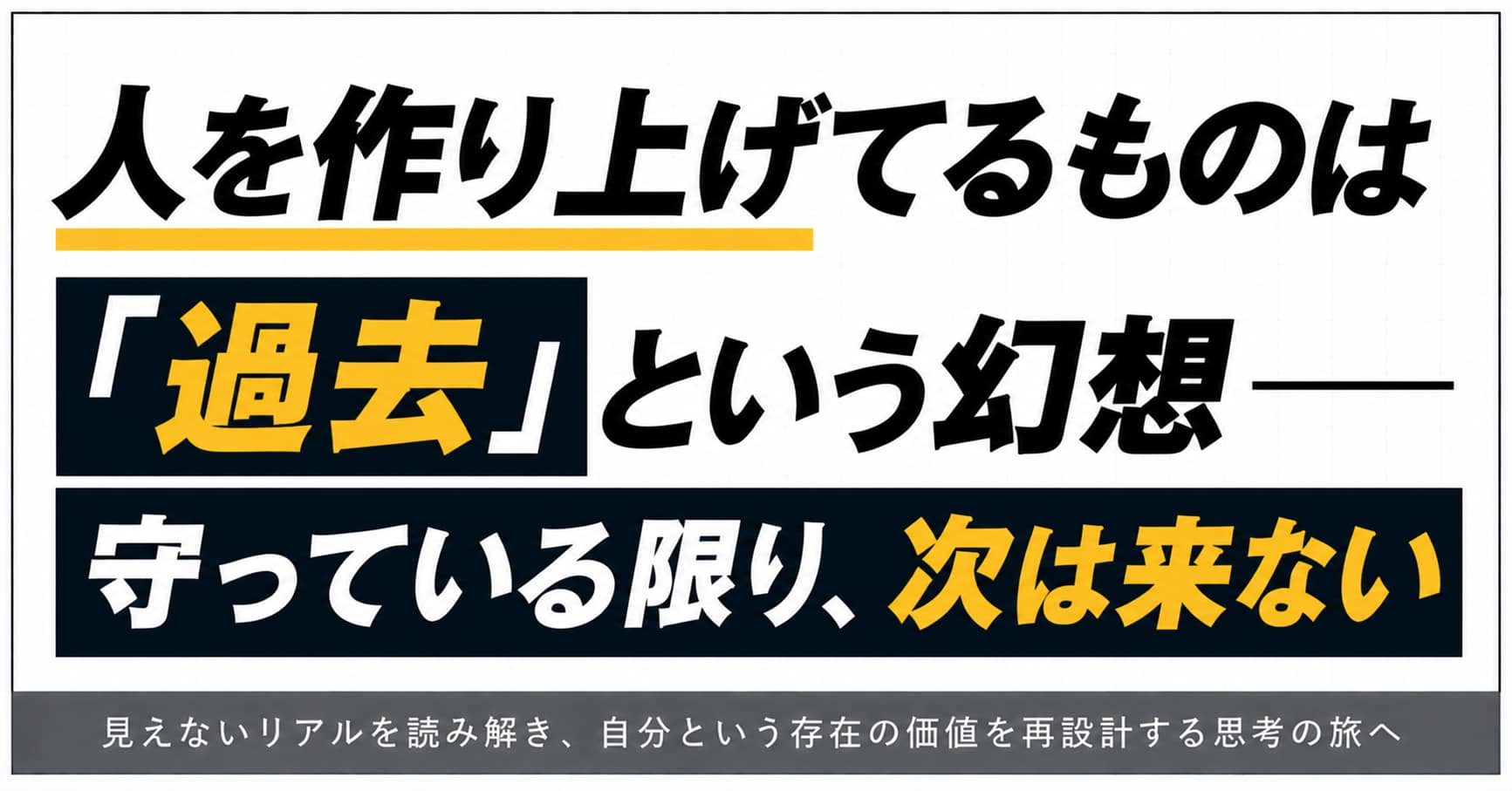
- What creates people is the illusion of a "past"—as long as we protect it, the next one won't come.
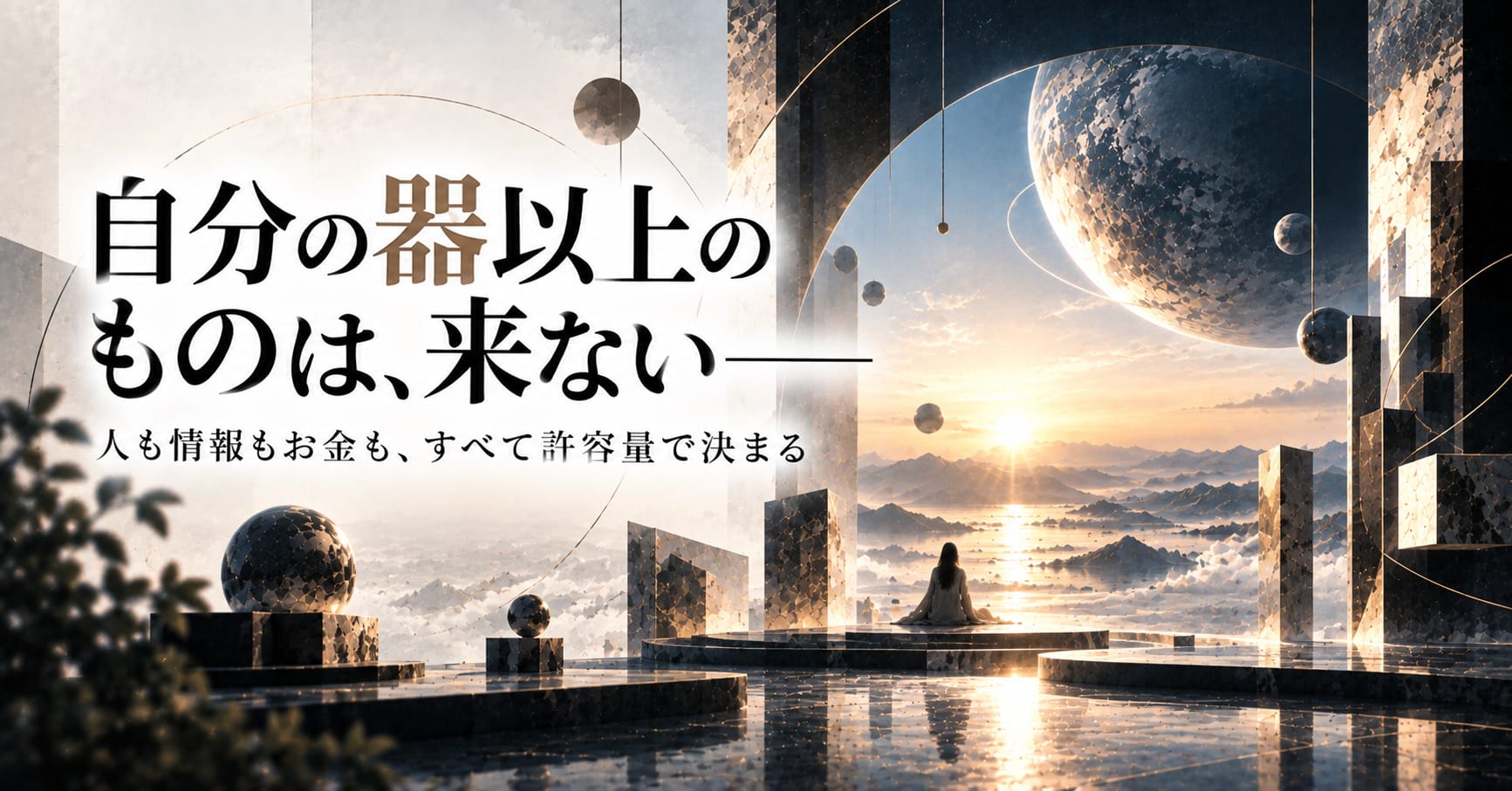
- Nothing is greater than your own capacity—no one, no information, no money, everything is determined by the limits of your tolerance.
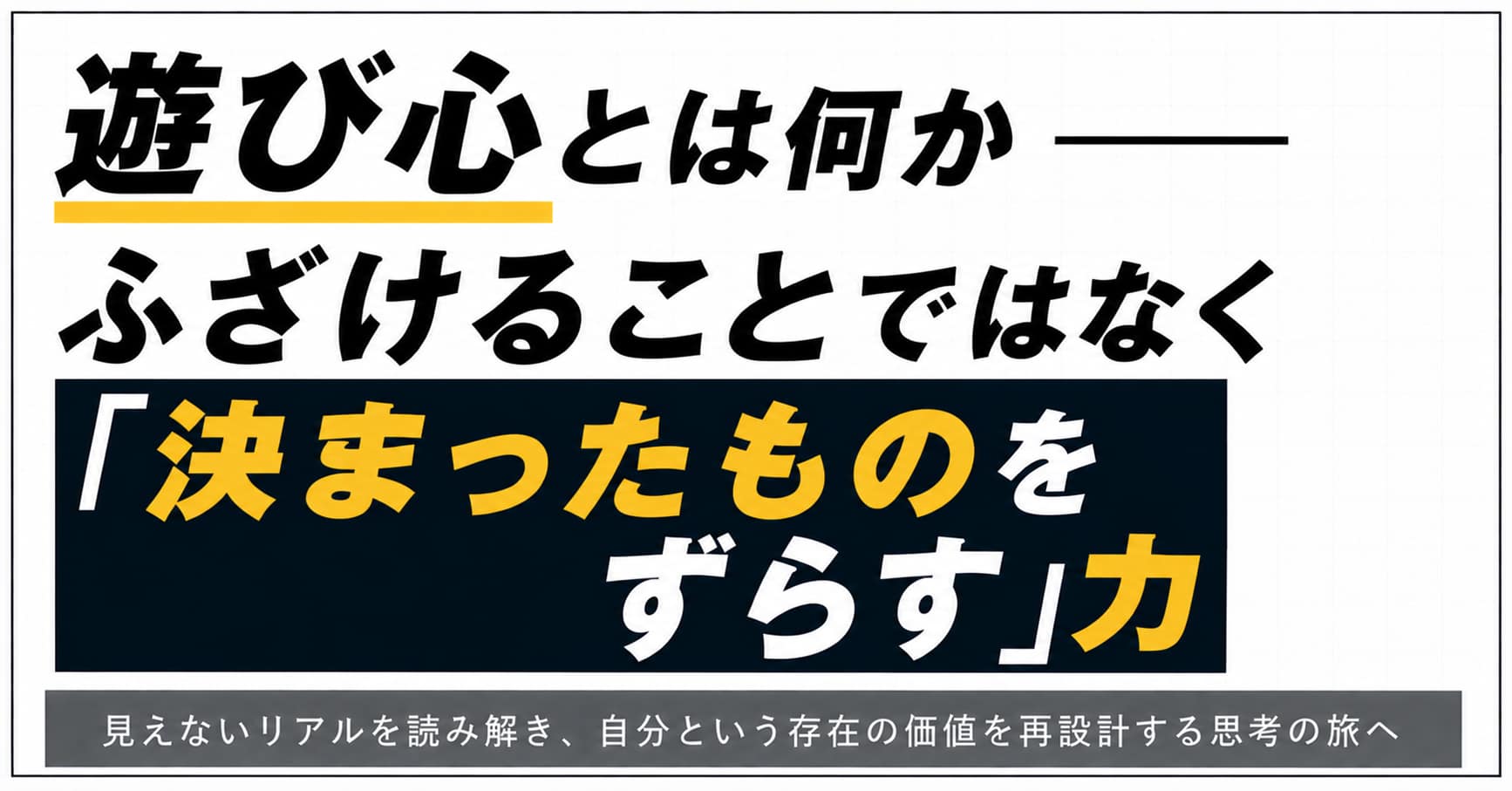
- What is playfulness? It is not about messing around, but the power to "shift the established."
Those who cannot see do not know they cannot see.
There is a strange asymmetry to the limits of perception.
Those who can see can grasp to some extent what those who cannot see are missing. Because they too were once unable to see. Having trodden the path, they understand the terrain.
However, those who cannot see cannot grasp what they cannot see. Because what they cannot see, they cannot see.
This is a state of "not knowing that you don't know." This is slightly different from Socrates' "knowledge of ignorance." Knowledge of ignorance is the state of "knowing that you don't know." This is already one step higher.
What's being said here is that it's one step further. The structural blind spot of "not even being able to know what you don't know." It's a state of not even seeing that there's a territory outside the map.
This blind spot is not due to laziness or foolishness. It is purely a structural issue where one's perspective has not yet reached that point.
No statement ever closes.
One of the principles of the extended imaginary theory is the following proposition.
"No statement ever closes."
No matter how precisely you describe it, you cannot fully capture the whole of a subject. This is not a limitation of ability, but a structural aspect of the act of description itself. Even if you write ten volumes of a biography, you cannot say, "Everything about this person has been written." Something will inevitably be left behind due to the structure.
There is a more important principle: "What is left behind is inside, not outside the object."
This means that what we cannot see is not "external information that has not yet been investigated." It is an unsegmented layer folded within the object itself. No matter how much information we gather, it is in a place that cannot be reached by quantitative expansion.
Having this principle as knowledge and understanding it with your body are entirely different. Someone who has it as knowledge can be humble, thinking, "There's still so much I don't know." Someone who understands it with their body moves while constantly "feeling" the existence of unseen areas. The latter is the viewpoint of a null-dimensional being.
The height of perspective is sensitivity to the breadth of id.
What do people with a high perspective see?
To give you the answer first, we are seeing the outline of things that are not visible.
People who only process the real dimension—meaningful information—deal only with what's in front of them. What can be confirmed, counted, named. They think that's the entirety of it.
Those sensitive to the虚次元 (virtual dimension) handle the real dimension D while sensing presences that have not yet manifested. They make judgments with the feeling that "something is here, though I can't see it yet."
This difference directly impacts the quality of judgment. A conclusion drawn solely from real-dimensional information is the optimal solution on the current map. A conclusion drawn by including the nuances of the virtual dimension is a judgment that incorporates doubt about the map itself. The latter is more honest in relation to reality.
Height of perspective is not the amount of what you see. It's sensitivity to what you don't see.
Those who possess virtual dimension abilities do not fear silence.
There is another thing they have in common.
Don't rush to an answer.
People optimized for processing in real dimensions quickly provide answers to questions. This is because not providing an answer appears as a lack of ability. They think silence is a sign of weakness. However, quick answers are answers that have cut off information from the "id." They are the result of moving fastest on the map but do not include what's outside the map.
Abstract dimension users have a tolerance for holding answers. They can treat "I don't know yet" as information, not a deficiency. They know that something will come from that holding.
This is not passive waiting. It is active dwelling within the *id*. Not rushing to make meaning, but keeping consciousness within the richness of the virtual. Within that time of suspension, deeper structures will naturally emerge.
A person who is not afraid of silence knows what lies within it.
To those who cannot see, what they cannot see is invisible. This is not a criticism. It is a description of structure.
And at the same time, it is also a description of my former self. No one could see everything before. What we see now, from a higher perspective, is still something we cannot see.
This structure can be changed. By repeatedly interacting with iD, the contours that were not visible will gradually become visible.
Perspective is not a talent. It is training.
↓If you want to know more about virtual dimension abilities, check out "Λ Meditation" now↓
↓Related articles are here↓
↓ Latest articles are here ↓
-

What creates people is the illusion of a "past"—as long as we protect it, the next one won't come.
People are made up of what they have built up through their lives. They must cherish and protect what they have built, rise from failure, and continue to waver between regret and hope...
-
Nothing is greater than your own capacity—no one, no information, no money, everything is determined by the limits of your tolerance.
No good news comes. There are times when I feel that I haven't been lucky. But it's not that I haven't received it; it's just that I haven't been able to receive it...
-

What is playfulness? It is not about messing around, but the power to "shift the established."
Don't be fooled by the idea that "playfulness equals fooling around." First and foremost, playfulness is not just about messing around and being lazy...