

Virtual Dimension Einstein × Virtual Dimension Yuma Muranushi "In the Age of Intelligence, How Do Humans Stand?." [Dialogue Project Part 3, Final Part] A Letter from the Doctor to People Living in the AI Era.
![☆Yuma Muranushi × Albert Einstein "How Do Humans Stand in the Age of Intelligence?" [Dialogue Project Episode 3, Part 2] A letter from the Doctor to people living in the AI age.](https://mlqu45y6h5tw.i.optimole.com/w:1024/h:538/q:mauto/f:best/https://iii-iii.com/i.media/wp-content/uploads/2026/05/4AA32F6C-5231-4947-8117-8EFD47CC41AE.png)
The setting for the third episode isn't the usual study. Suguri brings a thin slate to the Doctor to show him the world of 2026. It's called a smartphone.
Einstein held it in the palm of his hand and gazed at it for a while in silence. Then, he murmured,
Part 1 is here.
- Act IV: The Last Sanctuary of Imagination
- Act V - From Comparison to Coordinates
- Act VI ── A Final Letter from the Doctor
- Epilogue — Putting the board back in my pocket
- The age of AI where the importance of momentum is increasing—After the gap in intelligence is eliminated by AI, what remains in the end
- How to turn the benefits of ecosystems destroyed by AI to the side of those who benefit from them—and how to leave the other half behind
- The era in which AI will make individuals the most powerful—the reason we stopped looking for abilities that can't be matched by AI
Act IV: The Last Sanctuary of Imagination
Einstein I once said, "Imagination is more important than knowledge." You quoted that last time, too.
Murakami Yes.
Einstein I think those words are becoming more and more significant with the advent of the AI era.
Murakami What does it mean?
Einstein Knowledge is no longer the exclusive domain of humans. Remembering facts, performing calculations, constructing sentences – machines you built do these things far better. This is something we must admit.
Murakami I have to admit.
Einstein So what is left for humans? I think it's imagination. The power to envision what doesn't yet exist. The playfulness to try impossible combinations. The courage to say outrageous things without fear of failure. These things don't come from statistical data.
Murakami Sir, isn't that a bit of wishful thinking? AI might be able to imagine things eventually.
— Einstein shakes his head. —
Einstein What I'm talking about is not "imagination as a function." I'm talking about "the imagination of a being who has a body and lives with wounds." My theory of relativity wasn't born from calculations on paper. It was born from the foolish daydream of my sixteen-year-old self, "What would it look like if I rode on a beam of light?" Machines cannot replicate that daydream. Because machines don't have sixteen years old.
Murakami There is no sixteen.
Einstein That's right. Machines don't have youth. They don't have heartbreak. They don't have that long darkness on the night you lose your mother. Therefore, the imagination of machines, no matter how far it goes, will never have the soil of human experience. —This is the third piece of advice. Do not belittle your own experiences. Mundane daily life, pain, and confusion are all fuel for your imagination. AI doesn't have that.
Act V - From Comparison to Coordinates
Murakami Sir, one of the things that torments modern people the most is "comparison." On this board, people peek into others' lives and keep comparing themselves. Someone's success, someone's appearance, someone's happiness. They constantly measure themselves against others.
Einstein That's hell for humans.
Murakami Yes.
Einstein There's one thing I can say from my physics studies. Comparison only has meaning within a relative frame of reference. Whether you're faster or slower than someone else can be completely reversed by changing the frame of reference. Comparison is that unstable.
Murakami So, what should people do?
Einstein Establish your own frame of reference.
Murakami holds his breath.
Einstein This is a story that applies to your theory as well. People can't be truly free as long as they're competing and declaring winners and losers on coordinates set by someone else. But a person who draws their own axis is no longer compared to anyone. It's because they can stand in a place where they are not compared.
Murakami ...That is my very observation of the void dimension.
Einstein Is that so? Then, here's the fourth piece of advice: Discard others' yardsticks and draw your own coordinates. That's not selfish. It's the only place where you can contribute to the world.
Act VI ── A Final Letter from the Doctor
Murakami Doctor, one last thing. If you could write just one letter to young people living today, what would you write?
— Einstein picks up his pen and thinks for a moment. Then, he slowly begins to write. —
To my dear friend of the 21st century.
In my era, humanity encountered the power of the atom. In your era, humanity learned to externalize intelligence itself. Both have been irreversible steps for humankind.
But don't forget. Every time a new power emerges, humanity is faced with the same question: "Are we worthy of using this?"
Do not run away from this question. This is the *only* thing I ask of you.
AI can answer in your stead, but it cannot become a "worthy being" in your stead. That can only be found in the accumulation of your own small daily choices.
Please, don't rush. Please, take a deep breath. Please, take some time to look up at the sky.
And please, never stop imagining.
Imagination is more important than knowledge. Consider this your legacy from me.
Albert Einstein
Einstein put down his pen and offered the paper to the village chief.
Murakami May I take this home?
Einstein Here you go. However, Mr. Yuma, this letter is not for you. It is for everyone you meet.
Epilogue — Putting the board back in my pocket
After the talk, Suguri put her smartphone back into her pocket. Einstein opened an old notebook on the desk and looked out the study window.
As he was leaving, Murakoshi glanced back once and asked, "Professor, are you afraid of AI?"
Einstein laughed.
“I fear only one thing: that humans stop wondering.”
The one thing I fear is that humans will stop being amazed.
The village chief bowed deeply and left the study. The winter light was already beginning to fade. But the slip of paper in his breast pocket was still warm.
Afterword
In the third episode, the professor left four pieces of advice and a letter for modern people. Have time to block out information. Ask questions yourself. Do not belittle your own experiences. Discard others' standards and draw your own coordinates. – And never stop being amazed. These words gain even more weight precisely because we are in the age of AI. What will the two of them discuss next time? Please look forward to it.
Composition, Text, and Editing – Suguri
↓The second virtual dimension talk is here↓
↓The first virtual dimension discussion is here↓
↓ Latest articles are here ↓
-
The age of AI where the importance of momentum is increasing—After the gap in intelligence is eliminated by AI, what remains in the end
This article examines what makes the difference in the AI era. In conclusion, it is said that "the part of the brain that is responsible for thinking and creating ideas..."
-
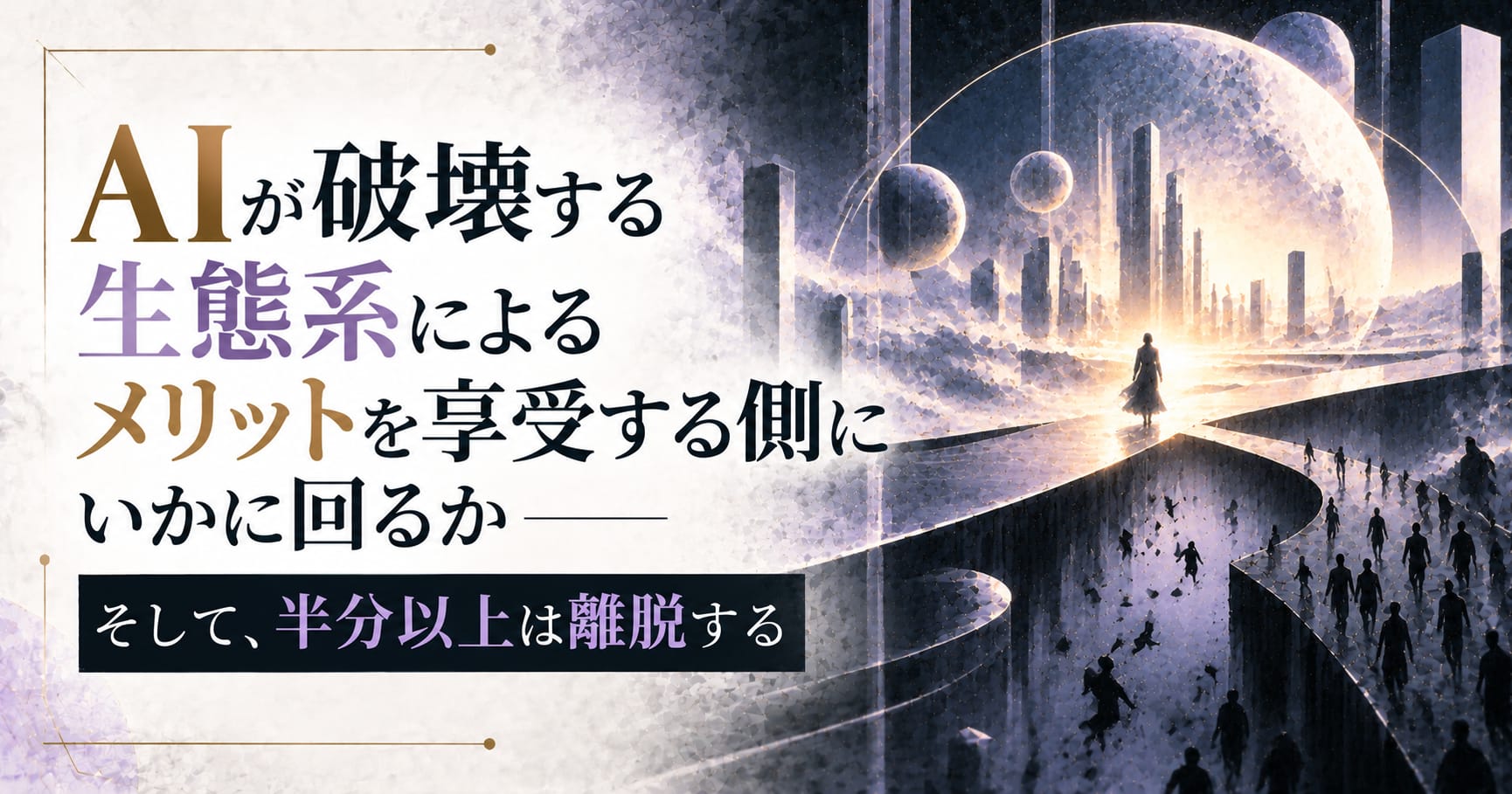
How to turn the benefits of ecosystems destroyed by AI to the side of those who benefit from them—and how to leave the other half behind
It is believed that businesses should start with what they want to do. However, the advent of AI is bringing a new wave to that. Sales…
-
The era in which AI will make individuals the most powerful—the reason we stopped looking for abilities that can't be matched by AI
Creating apps that only you use every day—replacing search or updating a handy tool for when you’re stuck—in an instant, now with AI…


