The true meaning of Wu Wei (non-action): not doing nothing, but an active way of "not doing something."
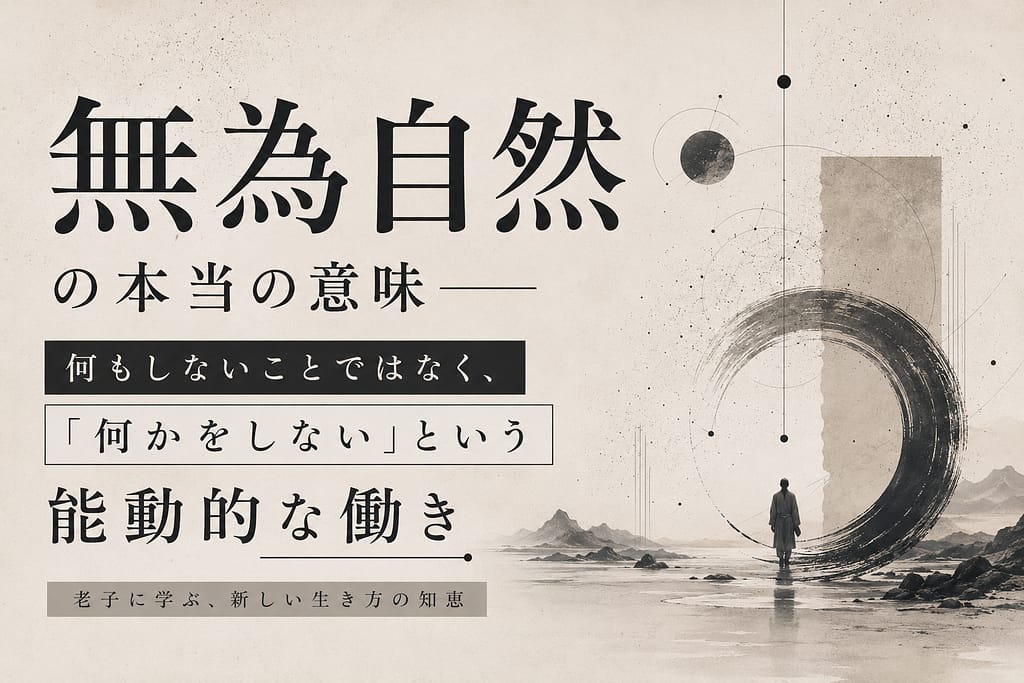
"Wu-wei ziran" is one of the central concepts expounded by Lao Tzu.
Literally, "living as one is" and "not interfering with human intervention" are the explanations. However, these explanations often cause misunderstandings. People tend to interpret "mui shizen" as "doing nothing."
If you do nothing, anyone can do it. Yet, why did Lao Tzu specifically advocate for "wu wei" (non-action) as an ideal?
Here lies the key to understanding the true meaning of wu wei.
- The Butcher of the Ox – What does "not using force" mean?
- The Structure of Non-Intervention: The Art of "Not Getting in the Way"
- Giving up actively, not passively—the most difficult work
- Wu Wei and Naturalness in Modern Times: A Prescription for the Pressure to "Control"
- Not wishing for world peace, but increasing practitioners who implement it: What lies between prayer and implementation
- Afghanistan Stay Journal Day 1: Hotels, Food, and Safety
- Now that AI is destroying the ecosystem, where do we stand? Vapors are being born in order.
The Butcher of the Ox – What does "not using force" mean?
Not touching bone isn't because you're not doing anything
There is a famous anecdote in *Zhuangzi* called "The Butcher Cutting Up an Ox."
When a skilled cook carves a bull, the blade moves naturally along the gaps, without hitting bones or tendons. The cook isn't using force. Nevertheless, the blade follows the most logical path.
Does this mean he’s “doing nothing”? No. The chef observes the structure of the food and moves his hands in accordance with that structure. He is constantly engaged in the active process of not forcing the knife through.
This is the true form of inaction.
The Structure of Non-Intervention: The Art of "Not Getting in the Way"
Maintaining the space where the original structure appears
Structurally rephrased, wu-wei and ziran becomes this.
Things have their own structure. A tree has its own form, and a river has its own flow. People also have their own material and direction.
"Action (intention)" means forcefully imposing a shape from the outside, ignoring the inherent structure. Conversely, "non-action" refers to maintaining a space where the inherent structure of the object can manifest on its own, without interference.
Lao Tzu's saying, "By doing nothing, nothing is left undone," implies this. It's a structural paradox where by not forcing things, their inherent power can be unleashed.
Giving up actively, not passively—the most difficult work
Don't grasp. Don't assume. Don't anticipate.
The important point here is that non-action is not passive relinquishment.
If you do nothing, it becomes indifference or laziness. This is not what wu-wei (non-action) is concerned with. It is the active effort of intentionally not doing something, and to do so continuously.
More specifically,
Don't try to grasp it.
Don't overinterpret.
Don't jump to conclusions.
Don't rush to get the answer.
All of these are not "doing nothing," but rather the activity of "intentionally not doing a specific thing."
Wu Wei and Naturalness in Modern Times: A Prescription for the Pressure to "Control"
The problems that Lao Tzu raised two thousand years ago continue to this day.
Our lives are filled with pressure to "grasp," "decide," and "control" in all sorts of situations. We gather information, analyze it, plan, and execute. While this proactivity certainly creates value, it also has the side effect of hindering the natural emergence of things.
Mui-shizen, or "natural inaction," is an ancient prescription offered for two thousand years to resist this pressure.
And the same structure is being rediscovered, with different vocabulary, in modern psychology, phenomenology, and management theory.
The true meaning of "wu wei, ziran" is not "doing nothing."
It is the most difficult form of proactivity: "intentionally not doing something."
Don't try to grab. Don't assume. Don't anticipate.
When you maintain that stance, the target will naturally emerge.
Lao Tzu's teachings are a structural technique for achieving maximum effectiveness at minimal cost.
↓Murakami's Second Paper, "A Structural Theory of Origins," is here↓
↓Related articles are here↓
↓ Latest articles here ↓
-

Not wishing for world peace, but increasing practitioners who implement it: What lies between prayer and implementation
Wishes do not change their structure even if the total amount increases. Even if the number of people wishing for peace doubles, the distribution of resources remains unchanged. Wishes are completed within the individual...
-

Afghanistan Stay Journal Day 1: Hotels, Food, and Safety
I am in Afghanistan. Japan still designates it as a travel-ban area, so the hurdles are quite high, but...
-

Now that AI is destroying the ecosystem, where do we stand? Vapors are being born in order.
The list of "jobs that will disappear" is useless. Job titles are merely loose bundles of work content. What actually disappears are the jobs...