
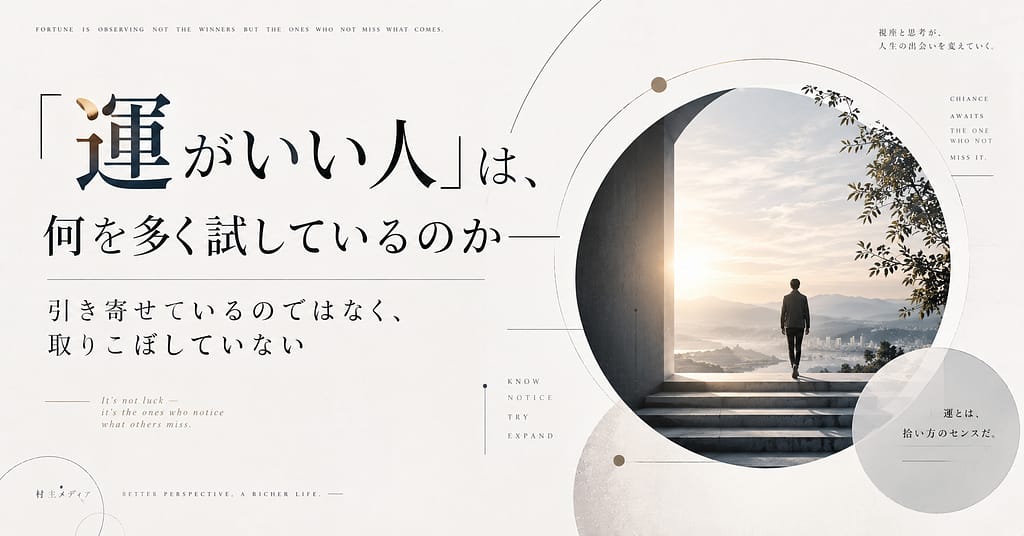
What "lucky people" try more of—they aren't attracting it, they just aren't missing it
- The "number of trials" theory is correct up to a point.
- The true nature of luck is not probability, but capture rate.
- It's not that they aren't coming; they're suppressing them.
- Crushing the uprising, three structures
- The more you want it, the less it comes.
- What creates people is the illusion of a "past"—as long as we protect it, the next one won't come.
- Nothing is greater than your own capacity—no one, no information, no money, everything is determined by the limits of your tolerance.
- What is playfulness? It is not about messing around, but the power to "shift the established."
The "number of trials" theory is correct up to a point.
What on earth is luck? First, the explanation that the true nature of luck is the volume of action is often heard. If you increase the number of times you step up to the plate, probabilistic hits will increase. Nothing happens to those who do nothing.
However, this explanation leaves something unexplained. This is because there are many people who clearly take a lot of action, yet nothing notable happens. They go where they're invited, raise their hand when opportunities arise, and meet people. And yet, their efforts continue to fall flat.
If it is not a matter of the number of plate appearances, where is the difference being made?
The true nature of luck is not probability, but capture rate.
Something is constantly arising in human consciousness. A subtle sense of discomfort that suddenly emerges in the middle of a conversation. A groundless snag in one's mind. The face of someone suddenly remembered. Things that, looking back later, can be called "turning points" usually first appear in this form.
And these are experienced not as things one has actively brought forth, but as things that have "arisen." They are not noticed by trying to notice them; rather, after the arising is over, it is recognized that they were already there. The order is reversed.
The problem is that most of these startups disappear without ever being captured.
── It's not that they aren't coming; they're suppressing it.
Here the perspective flips. Lucky people do not attract more things than others. They simply receive what comes to them just as much, without crushing it.
If so, what needs to be increased is not the number of at-bats, but rather reducing missed opportunities.
Crushing the uprising, three structures
The factors preventing reception can be roughly categorized into three.
The first is a state where the net of meaning is already filled. A conclusion has already been reached within oneself regarding that topic, and there is structurally no room for anything new to enter.
The second is a state where interpretation gets ahead of experience. No matter what is seen or heard, the moment it is perceived, it is sorted into existing mental drawers. What emerges is forced into a framework before it can take on its own unique form.
The third is a state where the drive to grasp results is too strong. The intention to "make this a success" dominates the room, suppressing any other potential sprouts.
── The more you want it, the less it comes.
The third one is the most troublesome. The desire to gain something and the fear of trying to avoid something. The stronger these two are, the narrower your field of vision becomes. You see only what you are aiming at, and things coming from unexpected directions pass by without ever entering your field of vision.
Therefore, a stance that is easy to receive is not a relaxed resignation. Nor is it doing nothing. It is about loosening preconceptions, not rushing to conclusions, and maintaining the margin of space until what is rising takes shape—a state of being active yet not trying to grasp.
This is not a special discipline; everyone experiences it in fragments. The moment you receive a sudden idea, the moment you effortlessly let go of a stubborn perspective, the moment you are able to wait without rushing to a conclusion. That is the feeling.
Opportunities don't come like obvious bolts of lightning. Most of the time, they come in the form of subtle anomalies you could easily ignore. How many of those you manage to pick up is perhaps what people later call "luck."
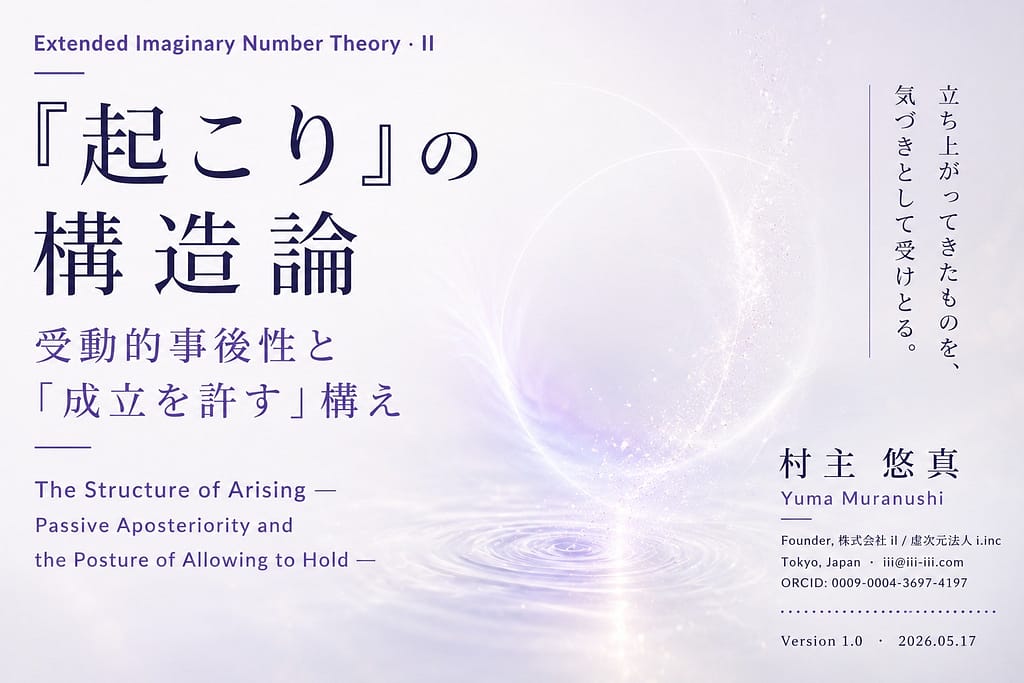
↓ Check out Muraji's second paper, "The Structural Theory of Origins," here ↓
↓For those who want to know more, check out Chapter III of the Theta Corridor: "Genesis and Transparency" now ↓

↓Check out the related articles here↓
↓ Latest articles are here ↓
-

What creates people is the illusion of a "past"—as long as we protect it, the next one won't come.
People are made up of what they have built up through their lives. They must cherish and protect what they have built, rise from failure, and continue to waver between regret and hope...
-
Nothing is greater than your own capacity—no one, no information, no money, everything is determined by the limits of your tolerance.
No good news comes. There are times when I feel that I haven't been lucky. But it's not that I haven't received it; it's just that I haven't been able to receive it...
-

What is playfulness? It is not about messing around, but the power to "shift the established."
Don't be fooled by the idea that "playfulness equals fooling around." First and foremost, playfulness is not just about messing around and being lazy...