

Numbers have been expanded while being negated—until imaginary numbers were accepted.
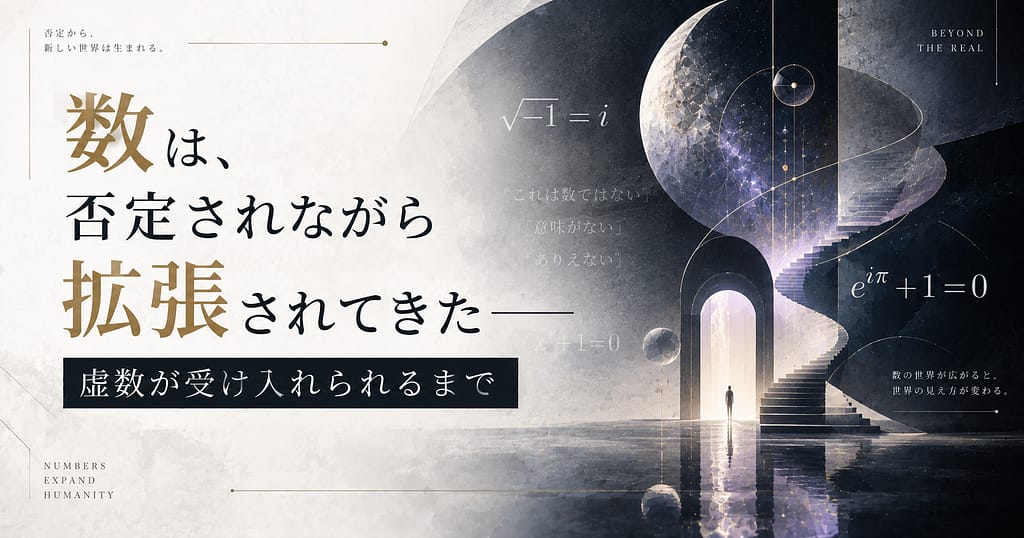
The history of numbers is a history of expansion. And that expansion has always met with resistance.
When arranged in order, the structure becomes visible.
- From natural numbers to negative numbers
- ── And the imaginary number
- What they have in common is that the description was never closed.
- ──Extended imaginary number theory is also connected to this lineage.
- Why express humans as functions?──The operations of abstraction and embodiment
- Numbers have been expanded while being negated—until imaginary numbers were accepted.
- Not wishing for world peace, but increasing practitioners who implement it: What lies between prayer and implementation
From natural numbers to negative numbers
It all started with natural numbers. They were numbers used for counting objects, directly connected to real-world experience.
Next are rational numbers. Divided numbers, like one-third, are added. Up to this point, they still correspond to real-world quantities.
And irrational numbers. Numbers like the square root of two, which cannot be expressed as fractions, appear. This marks the point where numbers emerge that cannot be written down within the existing system.
It is said that negative numbers were generally accepted in the seventeenth century. For a long time, there was no answer to the question of what a negative quantity actually was.
── And the imaginary number
A number that squares to minus one. Simple by definition, yet no corresponding quantity exists in reality, and above all, it runs counter to intuition. That is why it came to be called an imaginary number. Initially, it was treated as nothing more than a matter of convenience.
What they have in common is that the description was never closed.
This history of expansion follows a consistent pattern. Situations arise that cannot be expressed using existing number systems. To describe these situations, a new type of number is required.
And every time, it begins with non-acceptance and denial. There is a period when they are treated as something that does not exist, as something imaginary.
However, once that number is acknowledged, problems that were previously unsolvable can be solved, and for convenience, people continue to use it. As a result, its usefulness accumulates, and it eventually becomes established as a formal number.
── Extended imaginary number theory is also connected to this lineage.
The extension from the number line to the complex plane corresponds to formulations such as Z = D + iD or the complex time structure of T = t + it.
And the relationship between the complex plane and meditation also lies along this extension. By tentatively setting the real dimension as observable consciousness and the imaginary dimension as potential consciousness, the rotation angle θ is treated as the depth of the self.
A new description is denied at first because there is no corresponding sense of reality. People treat things that they cannot feel as if they do not exist.
However, the history of numbers shows that whether something feels intuitive and whether it is necessary as a description are two different things. How much value there is in deviating from intuition! The history of numbers is also the history of how humanity has accepted this.
↓Murakumo's first thesis "Extended Imaginary Theory" is here↓

↓Check out "Theta Corridor" right now if you want to learn more about imaginary numbers↓

↓Check out the related articles here↓
↓ Latest articles are here ↓
-

Why express humans as functions?──The operations of abstraction and embodiment
Writing humans as functions. Many people feel resistance to this format. The reaction is that treating people with mathematical formulas is cold. But th…
-
Numbers have been expanded while being negated—until imaginary numbers were accepted.
The history of numbers is a history of expansion. And that expansion has always faced resistance. When arranged in order, a structure emerges. Natural numbers...
-

Not wishing for world peace, but increasing practitioners who implement it: What lies between prayer and implementation
Wishes do not change their structure even if the total amount increases. Even if the number of people wishing for peace doubles, the distribution of resources remains unchanged. Wishes are completed within the individual...