
Why "going with the flow" works: The experience of the world moving while you stay still

Looking back on my life, there are moments that remain in my memory as decisive turning points.
What's common in those moments is, strangely, a weakened sense of having "chosen." Rather, they are remembered with the feeling that the world itself rearranged, as if you weren't the one moving.
The phrase "go with the flow" captures the essence of this experience.
- That moment when you lack the feeling of having personally chosen it
- Turning points in life have a mysterious common structure.
- The stance of trying to grasp limits what can be seen.
- The drawbacks of an active stance and what its retreat opens up
- As the perspective broadens, the scale of what occurs also changes.
- The structural essence of the experience "the world is moving"
- To do nothing
- Maintaining an active stance of not trying to grasp it.
- Not wishing for world peace, but increasing practitioners who implement it: What lies between prayer and implementation
- Afghanistan Stay Journal Day 1: Hotels, Food, and Safety
- Now that AI is destroying the ecosystem, where do we stand? Vapors are being born in order.
That moment when you lack the feeling of having personally chosen it
Turning points in life have a mysterious common structure.
Here is a concrete example.
The path I had been hesitating over for a long time was suddenly decided by a casual remark someone made during a conversation. It wasn't advice or a suggestion, just a fragment of conversation. Yet, the moment I heard it, a certainty arose: "This is it."
The moment you stand in a certain place, the direction of "this is what I will do" appears not as a choice, but as a given. The decision is not the result of careful consideration. Standing in that place itself initiated the decision.
Someone you weren't supposed to meet appears out of nowhere, even though you've done nothing. The timing is too perfect to be a coincidence, yet it can't be said that you actively brought it about.
What seemed like an unfortunate event, in hindsight, turned out to be a turning point in the direction I should have gone. Without that event, I couldn't have moved forward. Nevertheless, it wasn't something I chose myself.
What these phases have in common is the feeling that the subject is not moving, but the world is moving.
The stance of trying to grasp limits what can be seen.
The drawbacks of an active stance and what its retreat opens up
Why does this happen?
There is one structural answer. We usually approach the world with an active stance of "taking out" or "grasping" an object. This stance is powerful, but it has one drawback. We can only grasp objects in the form we anticipate beforehand.
"To let oneself go with the flow" means to let go of this active stance. When the pressure to grasp loosens, things that were previously overlooked because they didn't fit within expected frameworks gain room to emerge.
This is not resignation or giving up. Rather, it's a stance that should be called "active non-intervention." It's continuously performing the active function of not over-determining the situation.
As the perspective broadens, the scale of what occurs also changes.
The structural essence of the experience "the world is moving"
And another important thing is that when this stance is taken, the scale of approaching events changes.
Not just small flashes of insight closed within oneself, but the space of relationships begins to move, and the entire arrangement of situations starts to reconfigure. As one's perspective broadens, the scale of what arises also expands.
On the broadest scale, occurrences are experienced not as "something arising within my cognition," but rather as "the world itself moving." This is the structure of moments remembered as turning points in life.
To do nothing
Maintaining an active stance of not trying to grasp it.
"Going with the flow" doesn't mean giving up on effort.
It is about maintaining an active stance of not trying to grasp things. Don't cloud the situation. Don't interpret things in advance. Don't try to seize them.
Then, even if I don't move, the world on its side starts to move.
That is the structural identity of the moments when life goes well.
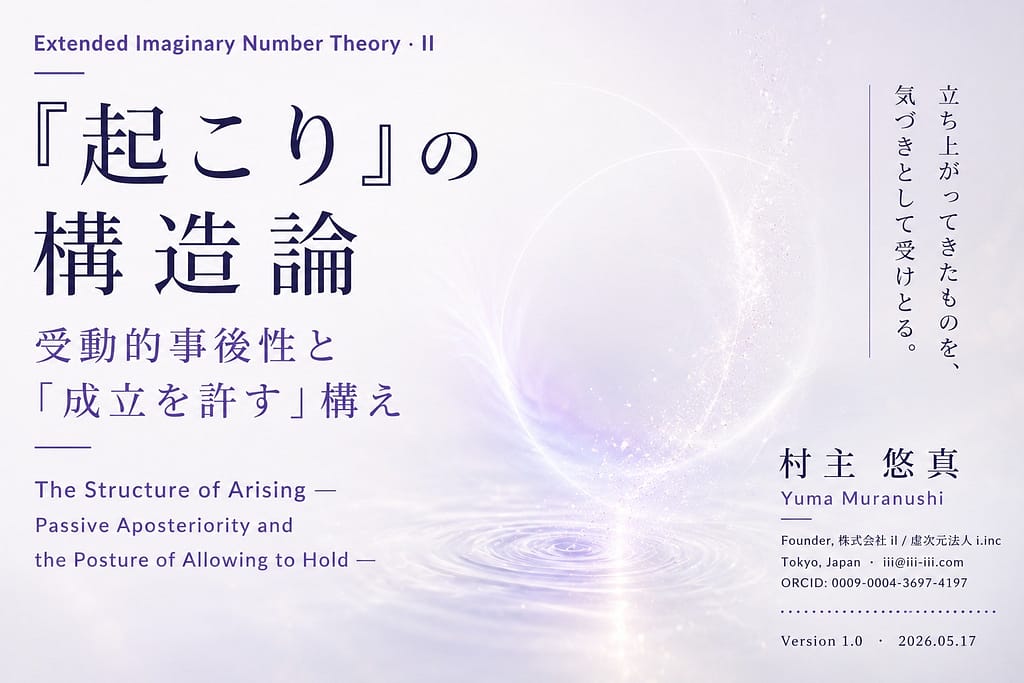
↓Murakami's Second Paper, "A Structural Theory of Origins," is here↓
↓Related articles are here↓
↓ Latest articles are here ↓
-

Not wishing for world peace, but increasing practitioners who implement it: What lies between prayer and implementation
Wishes do not change their structure even if the total amount increases. Even if the number of people wishing for peace doubles, the distribution of resources remains unchanged. Wishes are completed within the individual...
-

Afghanistan Stay Journal Day 1: Hotels, Food, and Safety
I am in Afghanistan. Japan still designates it as a travel-ban area, so the hurdles are quite high, but...
-

Now that AI is destroying the ecosystem, where do we stand? Vapors are being born in order.
The list of "jobs that will disappear" is useless. Job titles are merely loose bundles of work content. What actually disappears are the jobs...