What is a Coordinate System: Expanding the Concept of ”Spatialization of Thought” Which is Decisively Different from Perspective or Standard
"Have your own axis," "Think on your own axis." - These are phrases I've been encountering more and more often lately.
However,What is a coordinate axis?Few people can explain this properly. And why must this word be ”coordinate axis” and not "perspective" or "standard"? The moment you understand this, the depth of your thinking changes by another level.
- The coordinate system is originally a mathematical term—a set of three elements: an origin, a scale, and orthogonality.
- Why ”coordinate axis” and not "viewpoint" or "standard"?
- To set up coordinate axes is to ”spatialise” a concept.
- What creates people is the illusion of a "past"—as long as we protect it, the next one won't come.
- Nothing is greater than your own capacity—no one, no information, no money, everything is determined by the limits of your tolerance.
- What is playfulness? It is not about messing around, but the power to "shift the established."
The coordinate system is originally a mathematical term—a set of three elements: an origin, a scale, and orthogonality.
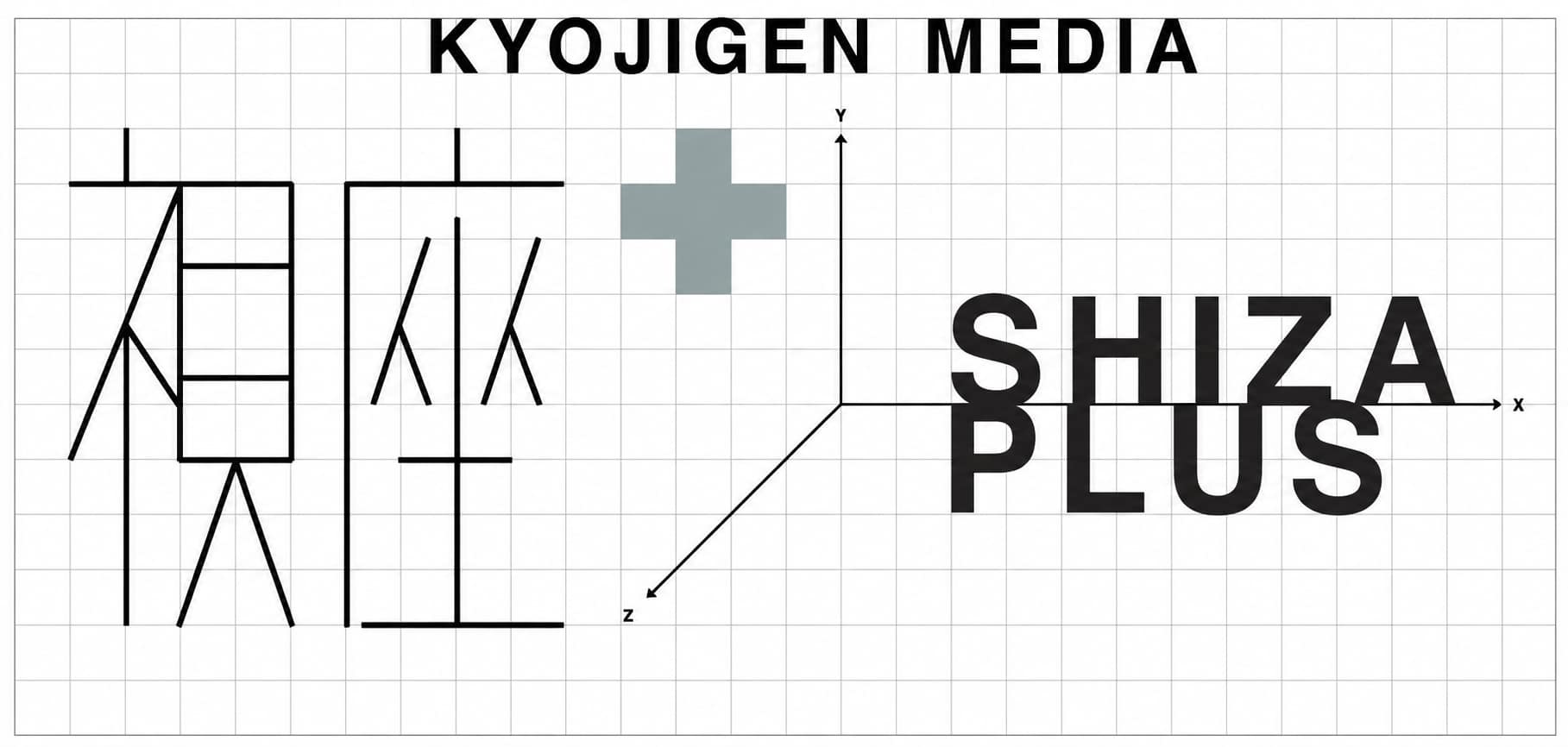
The term "coordinate axis" originally comes from mathematics. The x-axis, y-axis, and z-axis each have independent directions that are orthogonal to each other, and they function as rulers to measure distance from a reference point called the origin. And it is only when those axes are combined that "Spaceis defined.
In other words, the coordinate axes simultaneously contain three attributes that are not present in any of their synonyms, such as "viewpoint," "standard," or "ruler."
First,There is an originSecond,The scale is markedThird,Being orthogonal to other axes。
Among the many "thinking words," only "coordinate axis" has these three components. The true meaning of the phrase "to have a coordinate axis" refers to the state of having these three components established within oneself.
Why ”coordinate axis” and not "viewpoint" or "standard"?
Here's the core point that many people get wrong.
"Viewpoint" only indicates a position. It lacks a scale and any relational structure with other viewpoints. "Standard" can draw lines of comparison, but it lacks direction. "Ruler" has a scale, but it is fundamentally confined to one dimension.
For these, only the coordinate axesPreserve direction, origin, scale, and orthogonality simultaneouslydoing.
The key to taking your thinking a step deeper is this:OrthogonalityThe concept of orthogonality means independence, where moving along one axis does not affect the values on the other axes. Only humans who can simultaneously have multiple independent axes can handle complex phenomena multidimensionally.
No matter how many viewpoints you add, they only expand two-dimensionally. The moment the axis stands, thought expands into ”space.” This is the decisive function, where the coordinate axes are different from any other thought idiom.
To set up coordinate axes is to ”spatialise” a concept.
The simplest way to adapt coordinate axes for thinking is to re-establish every concept as an "axis."
For example, "freedom." Instead of treating it as a mere value, treat it as a single axis with a scale from 0 to 100. Then, in combination with other axes—order, responsibility, solitude—Be able to measure your current coordinatesThe vague self-awareness of "valuing freedom" transforms into concrete coordinates of "Freedom 80, Order 40, Responsibility 70." Thought shifts from a fog of words to spatial positioning.
Reframing things that cannot be captured by visible reality onto orthogonal, imaginary dimensional axes – this is the greatest aspect of the term "coordinate axis."Concept ExpansionThat's right.
Instead of people who increase perspective,Someone who upholds principlesOnly we can spatialize thought.
To see the world is to establish a coordinate system. That is one's perspective.
↓ For those who want to learn more about coordinate axes, check out the "Theta Corridor" now ↓
If you've read the article about coordinate axes, you might also like this one:
↓Click here for the latest articles↓
-

What creates people is the illusion of a "past"—as long as we protect it, the next one won't come.
People are made up of what they have built up through their lives. They must cherish and protect what they have built, rise from failure, and continue to waver between regret and hope...
-
Nothing is greater than your own capacity—no one, no information, no money, everything is determined by the limits of your tolerance.
No good news comes. There are times when I feel that I haven't been lucky. But it's not that I haven't received it; it's just that I haven't been able to receive it...
-

What is playfulness? It is not about messing around, but the power to "shift the established."
Don't be fooled by the idea that "playfulness equals fooling around." First and foremost, playfulness is not just about messing around and being lazy...