

Not being able to find an answer even after thinking about it doesn't mean you're stupid—there are two types of questions.

- They may look like the same "no answers found," but the contents are different.
- A model where the shaft you bring becomes the tool as it is
- A mold that doesn't become a platform to put the answer on, even if you add an axis
- The true nature of what seems like a vicious circle
- Only one distinguishing question is needed.
- Do not call a question with no answer a failure.
- For Those Who Want to Learn More
- The age of AI where the importance of momentum is increasing—After the gap in intelligence is eliminated by AI, what remains in the end
- How to turn the benefits of ecosystems destroyed by AI to the side of those who benefit from them—and how to leave the other half behind
- The era in which AI will make individuals the most powerful—the reason we stopped looking for abilities that can't be matched by AI
- Frequently Asked Questions
They may look like the same "no answers found," but the contents are different.
I can't see a path to success for the new business. My relationship with that person isn't improving. I don't know why I'm working.
They all seem like dead ends. But they’re different in nature.
The first one will be settled once I have all the materials. The second one will probably be settled. The third one keeps coming back in a different form every time I think about it.
An impasse is a state in which the framework currently in use is no longer able to capture the subject. It is only after that point that a bifurcation occurs.
A model where the shaft you bring becomes the tool as it is
Just relying on your gut feeling about business isn’t enough to tell if you’re actually making a profit. But when you apply the framework of debits and credits, things that were previously invisible find a place to be expressed in numbers.
Even a location that could only be described as “around there” becomes something anyone can understand the moment you add vertical and horizontal axes.
Imaginary numbers in mathematics fall into this category as well. Among the real numbers, there was no way to represent a number that, when squared, equals −1. By adding a single axis labeled “i,” that number can be written as “i.”
In this model, the combined axis itself becomes a tool for description. Since we can now describe what we previously could not, the cause of the impasse has been resolved. Therefore, the story ends there.
This is called "device expansion."
A mold that doesn't become a platform to put the answer on, even if you add an axis
Let’s consider the question, “What am I?” One answer emerges: I am the sum total of the choices I have made so far.
I wrote it. But the moment I wrote it, I found myself standing outside of it. The “me” who is now looking at the definition I just wrote is not included within that definition.
So I think again. And the same thing happens again.
In this mold, the axis does not become a tool. The only thing acknowledged is the singular fact that "there is one place where description does not reach," not the contents of that place. The added axis is not a platform to support an answer, but remains on the side of the conditions for continuing to think.
This is called "surplus approval."
The true nature of what seems like a vicious circle
With redundant approval, the more you write, the more a new outside is created, exactly proportional to what you wrote.
This isn’t just going around in circles. The moment something is written down, it becomes a result, and what came before it recedes even further. Each time, it takes a clear step forward, and the outside world is updated by the same amount.
Even though it hasn't stopped, it doesn't end. Not ending is different from not moving forward.
The term “infinite regress” implies that the argument has failed somewhere along the line. However, what is happening here is not a failure, but rather a structure in which this type of question accurately predicts its own outcome.
Only one distinguishing question is needed.
Did the axis you brought in become a tool, or did it remain just a condition?
If it becomes a tool, the answer will come. Just keep working. If the conditions remain the same, the answer won't come. It would be wrong to think at this point that "you're not trying hard enough."
Real-life worries are usually a mix of different issues. The worry that a business isn’t growing encompasses both aspects—one that can be resolved simply by getting the numbers in order, and another that involves figuring out what you actually want to do. Because you carry them together without separating them, even the parts that should be easy to resolve end up feeling like a heavy burden.
First, I isolate the parts that can be resolved through technical enhancements and handle them matter-of-factly. What remains is the other issue.
Do not call a question with no answer a failure.
Mathematics closed by adding a single axis. This is because the added axis became a tool. The question of existence has remained open for two thousand years not because the capacity of those who think is inferior, but because the axis being handled remains on the side of conditions.
It is not a question of which is better. Their structures are different.
You can carry that question with you even without finding an answer. In fact, it is that unanswerable question that has kept that person going for years.
Is this a problem to be solved and left behind, or a question to be carried with us as we walk?
The moment you separate them, one becomes lighter, while the other remains heavy enough to hold.
For Those Who Want to Learn More
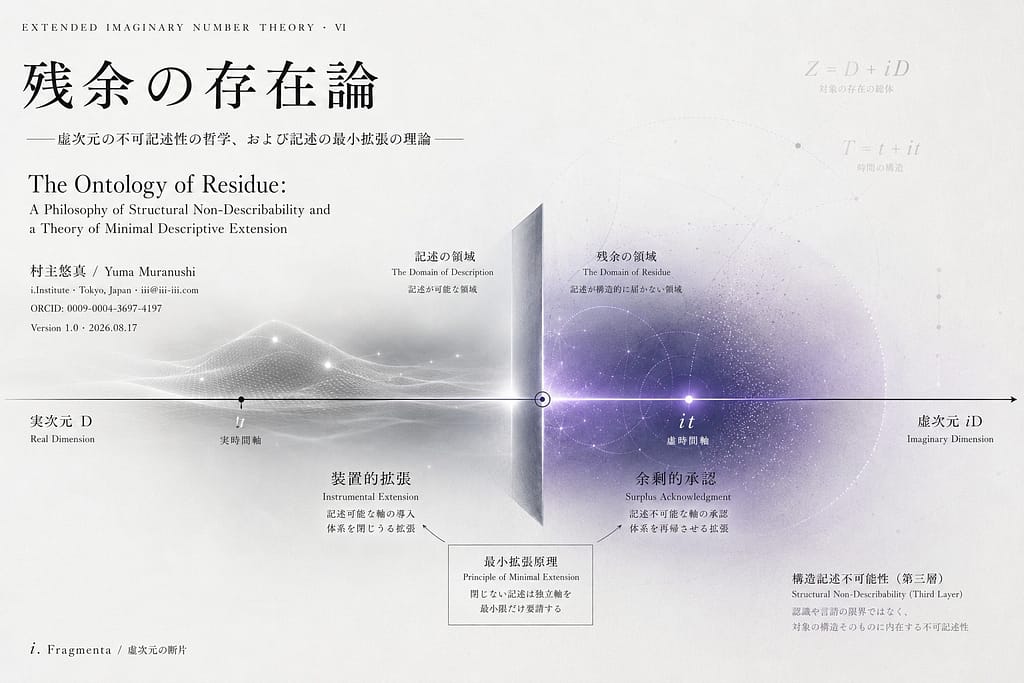
The dichotomy between “apparatus-based extension” and “surplus recognition,” as well as the proposition that “whether an extension is completed or recurs depends on whether the requested residue itself becomes describable,” is formulated in the sixth paper of the series on the theory of extended imaginary numbers.
↓Click here for *The Ontology of the Residual: A Philosophy of the Indescribability of the Imaginary Dimension and a Theory of the Minimal Extension of Description* (Yuma Murashu, 2026)↓
For details on the dual structure of existence as the starting point, see the first paper.
↓Click here for “Extended Imaginary Theory: Z = D + iD as the Dual Structure of Existence” (Yuma Murashu, 2026)↓

↓Related articles are here↓
↓Latest posts are here↓
-

The age of AI where the importance of momentum is increasing—After the gap in intelligence is eliminated by AI, what remains in the end
This article examines what makes the difference in the AI era. In conclusion, it is said that "the part of the brain that is responsible for thinking and creating ideas..."
-

How to turn the benefits of ecosystems destroyed by AI to the side of those who benefit from them—and how to leave the other half behind
It is believed that businesses should start with what they want to do. However, the advent of AI is bringing a new wave to that. Sales…
-

The era in which AI will make individuals the most powerful—the reason we stopped looking for abilities that can't be matched by AI
Creating apps that only you use every day—replacing search or updating a handy tool for when you’re stuck—in an instant, now with AI…
Frequently Asked Questions
No. There are two types of questions: those that can be resolved by adding a new axis, and those that do not yield a solution even when an axis is added.
When you introduce a new axis, you can tell whether it becomes the tool that provides the answer.
Rather than calling it a failure, it’s about not letting it fester and continuing to keep it going. Even if it seems like a never-ending cycle, it makes sense.


