
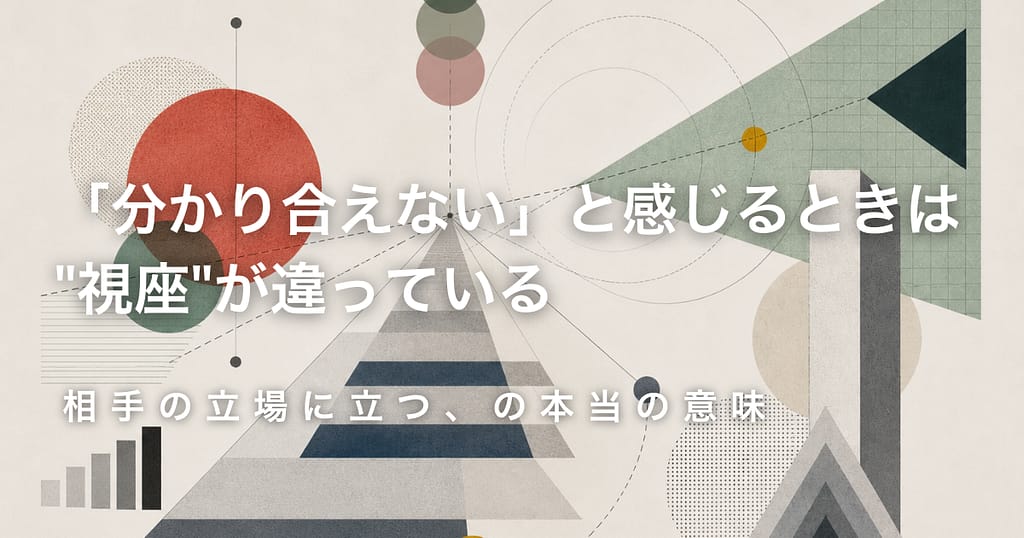
When you feel ”incompatible,” it's because your "perspective" is different – the true meaning of "putting yourself in the other person's shoes."
Even though we're speaking the same language, we can't understand each other. No matter how many times I explain, their face clouds over. If I dismiss it as a difference in values, it would end there, but each time I do that, I grow a little more weary of human relationships.
When we feel like we "can't understand each other," what's really happening might not be a conflict of opinions.
- Imagining feelings is imagining a point of view.
- You can't fully put yourself in someone else's shoes.
- “Putting yourself in the other person's shoes” isn't about finding the right answer.
- The reason we can't understand each other isn't a difference in opinion, but a difference in perspective.
- The world becomes just a little bit kinder.
- What creates people is the illusion of a "past"—as long as we protect it, the next one won't come.
- Nothing is greater than your own capacity—no one, no information, no money, everything is determined by the limits of your tolerance.
- What is playfulness? It is not about messing around, but the power to "shift the established."
Imagining feelings is imagining a point of view.
When we say we can understand other people's feelings, we're always a little cautious.
Feelings aren't just made of emotions alone. What kind of ground a person stands on, what history they carry, what they take for granted, and what they consider an exception. Things like thatViewpointbut it shapes the form of emotion.
So, imagining feelings is actually also imagining the "perspective" that is the source of those feelings.
You can't fully put yourself in someone else's shoes.
Of course, it's impossible to completely put yourself in someone else's shoes.
We grew up in different places, different eras, and have different bodies. Even when using the same words, the weight those words carry is different for each person.
Even so, the moment you stop imagining, the world becomes very small.
When people can no longer see others as individuals standing on different perspectives, they easily fall into the trap of dismissing them as "wrong" or "uninformed." The feeling of not being able to understand each other actually occurs just before this dismissal.
“Putting yourself in the other person's shoes” isn't about finding the right answer.
"Let's try to think from the other person's perspective" is often said. However, these words sometimes sound burdensome.
Trying to stand in someone else's shoes isn't about finding the right answer. It starts with acknowledging that, "My perspective isn't the only one."
Just acknowledging it makes a big difference. You no longer have to force the other person's words onto your own map.There might be another map.You'll start to feel that way. There are many innovative rules there that you can't imagine.
The true meaning of "putting yourself in someone else's shoes" is not about guessing their answer, but about acknowledging the existence of their map.
The reason we can't understand each other isn't a difference in opinion, but a difference in perspective.
When you feel like you can't understand others, it's usually not because you have different opinions, but because you have different perspectives.
Discussions of opinions can sometimes go in circles. As long as "who is right" is debated on the same footing, the gap can never be bridged.
However, when you realize the difference in perspectives, the discussion actually deepens. This is because the question shifts to "Why does this person see it that way?" When the question changes, the very landscape of human relationships transforms.
The world becomes just a little bit kinder.
You don't have to fully step into someone else's shoes. Just start by being aware that "there is another viewpoint there." That alone can shift the feeling of not understanding each other from hostility to something closer to curiosity.
At that moment, the world becomes a little gentler than before.
↓If you want to learn more about perspective, check out "θ Corridor" now.↓
↓If you've read this article from this viewpoint, we also recommend this article.↓
-

What creates people is the illusion of a "past"—as long as we protect it, the next one won't come.
People are made up of what they have built up through their lives. They must cherish and protect what they have built, rise from failure, and continue to waver between regret and hope...
-
Nothing is greater than your own capacity—no one, no information, no money, everything is determined by the limits of your tolerance.
No good news comes. There are times when I feel that I haven't been lucky. But it's not that I haven't received it; it's just that I haven't been able to receive it...
-

What is playfulness? It is not about messing around, but the power to "shift the established."
Don't be fooled by the idea that "playfulness equals fooling around." First and foremost, playfulness is not just about messing around and being lazy...