第六論文
残余の存在論
虚次元の不可記述性の哲学、および記述の最小拡張の理論
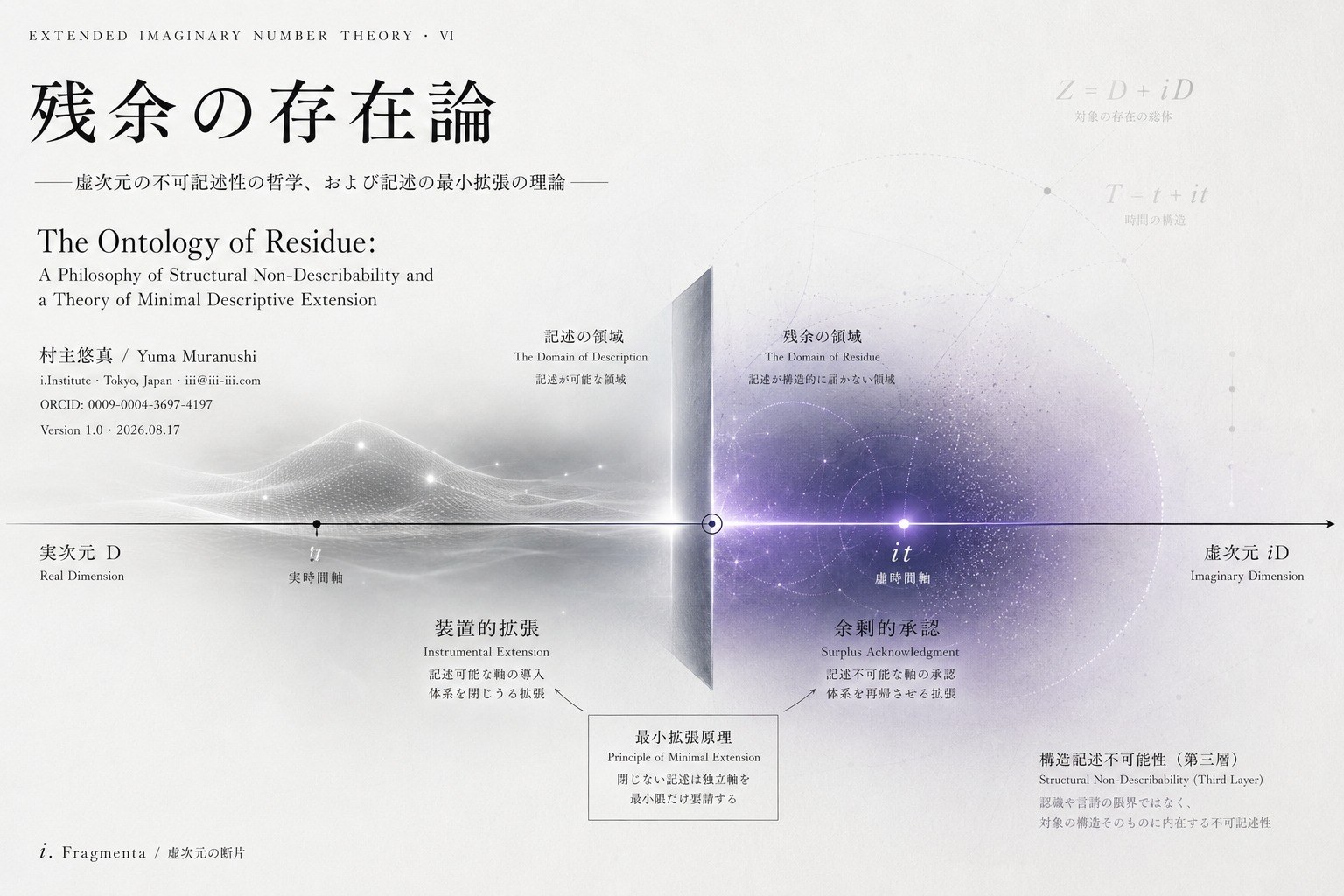
なぜ数学の拡張は完結し、存在の記述は完結しないのか。最小拡張を装置的拡張と余剰的承認の二形態に分け、その差が「閉じる拡張」と「永遠に再帰する拡張」を分けることを示す。
なぜ数学の拡張は完結し、存在論的記述の拡張は完結しないのか。実数体は、代数的に閉じないという事態に一本の軸——虚数単位 i を加えることで閉じた。だが実次元の記述は、虚次元 iD を承認してもなお閉じない。本稿はこの差の根拠を、拡張の再帰性——不可記述な位置を承認する記述が、そのつど新たな残余を産む構造——に求める。本稿は、拡張虚数理論シリーズの第六論文として、二つの作業を行う。第一に、先行五論文を貫く記述様式——虚次元を直接記述せず、その存在を構造的に要請する様式——の自己制限が五段階を経て累積し、この累積が消極的なブレーキではなく、より深い領域への踏み込みを可能にする条件であったことを示す。第二に、この様式の核にある操作を残余の理論として定式化する。第五論文が原理化した最小拡張——閉じない記述は独立軸を最小限だけ要請する——は、導入される軸それ自体の記述可能性を基準に、装置的拡張と余剰的承認とに二分される。前者のみが体系を閉じさせうる(命題 P1a)のに対し、後者は必然的に再帰する(命題 P1b)。虚数単位 i の増設・虚時間 it の要請・虚次元 iD の承認というシリーズの三操作は、この単一の分類のもとに統合され、第五論文が後続の課題とした構造的同時性も、この理論の系として与えられる——その適用は、前件が論証された体系(実時間軸 t)に限定される。本稿の帰結は一つの命題に集約される——記述体系は、自らが閉じないことにおいてのみ、自らを超えて拡張されうる。そして、その拡張が完結するか再帰するかは、要請された残余それ自体が記述可能になるか否かで決まる。
Why does extension in mathematics terminate, while extension in ontological description does not? The field of real numbers, confronted with its failure to be algebraically closed, was closed by the addition of a single axis: the imaginary unit i. The description of the real dimension, by contrast, does not close even once the imaginary dimension iD has been acknowledged. This paper locates the ground of that difference in the recursivity of extension — the structure whereby a description that acknowledges a non-describable position generates, with each acknowledgement, a further residue. As the sixth paper of the Extended Imaginary Number Theory series, it undertakes two tasks. First, it shows that the self-limitation running through the preceding five papers — the mode of description that never describes the imaginary dimension directly but requires its existence structurally — accumulated across five stages, and that this accumulation functioned not as a negative brake but as the condition enabling entry into deeper territory. Second, it formalises the operation at the core of that mode as a theory of residue. Minimal extension, established as a principle in Paper V — a description that fails to close requires an independent axis, and only the minimum required — divides in two by the criterion of whether the introduced axis is itself describable: into instrumental extension and residual acknowledgement. Only the former can bring a system to closure (Proposition P1a); the latter necessarily recurs (Proposition P1b). The three operations the series has performed — the addition of the imaginary unit i, the requirement of imaginary time it, and the acknowledgement of the imaginary dimension iD — are unified under this single classification, and structural simultaneity, left by Paper V as a task for subsequent work, is likewise given as a corollary of the theory; its application is restricted to systems whose antecedent has been argued for (the real time axis t). The conclusion of this paper contracts into a single proposition: a descriptive system can be extended beyond itself only in virtue of failing to close, and whether that extension terminates or recurs is settled by whether the required residue itself becomes describable.
キーワード 不可記述性 / 構造的余剰 / 最小拡張原理 / 装置的拡張 / 余剰的承認 / 再帰性 / 構造的同時性 / 虚次元 / 構造的回避 / 拡張虚数理論
KEYWORDS non-describability / structural surplus / principle of minimal extension / instrumental extension / residual acknowledgement / recursivity / structural simultaneity / imaginary dimension / structural avoidance / extended imaginary number theory
HOW TO CITE —— 引用形式
Muranushi, Y. (2026). The ontology of residue: A philosophy of structural non-describability and a theory of minimal descriptive extension [Preprint]. Zenodo. https://doi.org/10.5281/zenodo.21974402
Muranushi, Yuma. 2026. “The Ontology of Residue: A Philosophy of Structural Non-Describability and a Theory of Minimal Descriptive Extension.” Preprint, Zenodo. https://doi.org/10.5281/zenodo.21974402.
@misc{muranushi2026residue,
  author       = {Muranushi, Yuma},
  title        = {The Ontology of Residue: A Philosophy of Structural Non-Describability and a Theory of Minimal Descriptive Extension},
  year         = {2026},
  howpublished = {Preprint, {\"\i}.Fragmenta No.~6, i.Institute},
  publisher    = {Zenodo},
  doi          = {10.5281/zenodo.21974402},
  url          = {https://doi.org/10.5281/zenodo.21974402}
}